From global risk to local strength

FinTech BizNews Service
Mumbai, 8 June 2026: As CFOs navigate an increasingly uncertain global environment, Deloitte has come out with an interesting report, titled “Optimism through uncertainty: CFO confidence defies global risk”. The findings highlight how Indian CFOs are balancing strong business confidence with heightened geopolitical and economic uncertainty, while accelerating efforts around resilience, innovation, and AI adoption.
Resilience not retreat
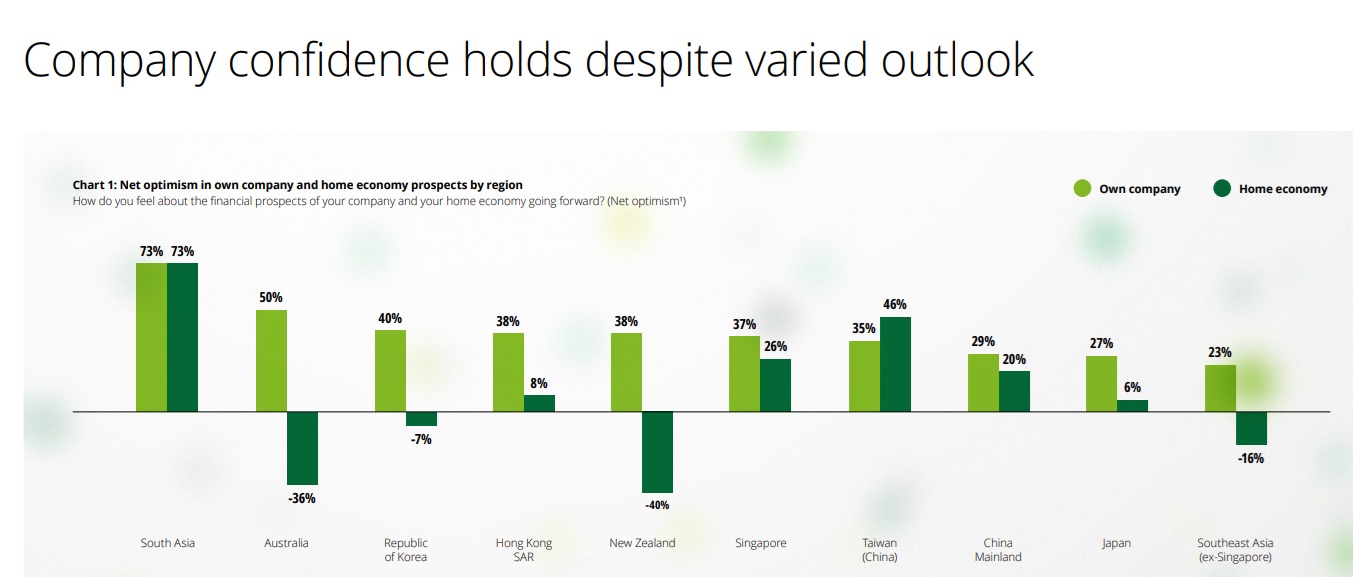
South Asia CFOs are the most strongly net optimistic about their own businesses compared to the AP average, at +73% versus +41% across AP; this is 63 percentage points above views on the global economy at net 10%, the only region in AP to record a positive outlook for the global economy ( -27% AP), while sentiment on the South Asian economy is also the highest across the AP countries surveyed at net +73%.
David Rumbens Partner Deloitte Access Economics: “Asia Pacific’s economic resilience is being tested by energy and input shocks which pose a near-term risk. The fundamentals of the region remain strong though, supported by regional trade and investment trends.”
Stay ready, stay flexible:
Most of the CFOs expect the Middle East conflict to negatively affect the global economy (93%) and South Asia economy (88%), and 79% expect a negative impact on their own business; 51% expect a significant negative global impact versus while only 10% expect a significant negative impact for their own business. Over 60% are tightening costs, and 53% are increasing focus on liquidity and cash management.
Kok Yong Ho CFO Programme leader, Asia Pacific and Southeast Asia: “CFOs are looking at the global environment with real caution, but what stands out is that they are not retreating. CFOs are leaning into what they can influence: sharpening performance, staying close to customers, protecting supply chains, while making disciplined moves to tighten costs and manage liquidity. As CFOs reinforce core fundamentals, they continue to build the capabilities that matter, and preserve their ability to invest quickly when opportunities arise.”
From global risk to local strength:
Geopolitical instability is the top disruption risk for South Asian CFOs (86% vs 82% AP), while supple chain disruption is the highest among regional peers (56% vs 43%). Growth priorities are innovation and new products (52%), increasing sales to existing customers (48%) and acquiring customers in existing geographies (46%).
Pacesetters not spectators
South Asian CFOs lag AP peers in AI adoption, with organisation adoption at 62% vs 67% AP and finance functions at 48% vs 59% AP already using AI; while extensive use is around regional averages showing challenges in scaling: 14% vs 13% for organisations and 6% vs 8% for finance functions.
Turning hype into hard numbers
More than half of the South Asian CFOs report some value from AI investments, slightly higher than AP peers (55% vs 52% AP) and none of them say they are exceeding expectations—one of the lowest in Asia Pacific.
Skills and data hold the key:
South Asian CFOs see skills (60% vs 56% AP) and data issues (48% vs 55% AP) as the top barriers to finance-function adoption; these are also the top action areas, with 65% prioritising training and upskilling and 51% tackling data-related challenges.
Nandita Pai, Partner and CFO Program Leader at Deloitte India, explains:
“Indian CFOs are entering the year ahead with unusual confidence, but it is confidence grounded in contingency planning. They are treating volatility as a practical constraint by tightening cash, cost and supply-chain resilience while pursuing innovation and deeper customer penetration. The next frontier is translating AI experimentation into repeatable operating advantage by moving from isolated use cases toward data-ready, scalable finance platforms and building the skills to match. CFOs who connect disciplined execution today with scalable digital capability tomorrow will be best placed to strengthen the finance function’s role in enterprise reinvention and convert uncertainty into competitive advantage.”
