The Global Cooperation Barometer 2026 reveals strong pressures on multilateral institutions are causing global cooperation to evolve rather than retreat.

FinTech BizNews Service
Mumbai, 8 January 2026: Global cooperation is proving resilient even as multilateralism continues to face strong headwinds, according to the World Economic Forum’s Global Cooperation Barometer 2026. However, cooperation is below where it needs to be to address critical economic, security and environmental challenges. Within a more complex and uncertain geopolitical context, open and constructive dialogue is a critical factor in identifying potential collaborative pathways that advance shared interests.
In its third year, the Global Cooperation Barometer 2026, developed in collaboration with McKinsey & Company, uses 41 metrics to assess the level of cooperation worldwide across five pillars: trade and capital; innovation and technology; climate and natural capital; health and wellness; and peace and security.
The 2026 Barometer indicates that the overall level of cooperation has largely been unchanged in recent years but the composition of cooperation appears to be evolving. Innovative, smaller collaborative arrangements are emerging, often within and between regions, as cooperation through multilateral avenues has weakened. Progress on global priorities has shown the greatest momentum when it aligns with national interests – with climate and nature and innovation and technology seeing relatively strong increases in cooperation. Other pillars, including health and wellness and trade and capital, have stayed flat. The peace and security pillar experienced the largest drop.
“Amid one of the most volatile and uncertain periods in decades, cooperation has shown resilience,” said Børge Brende, President and CEO, World Economic Forum. “While cooperation today may look different than it did yesterday, collaborative approaches are essential to grow economies wisely, accelerate innovation responsibly and prepare for the challenges of a more uncertain era. Flexible, nimble and purpose-driven approaches are most likely to withstand the current turbulence and deliver results.”
“Leaders are reimagining collaboration across borders,” said Bob Sternfels, Global Managing Partner, McKinsey & Company. “Cooperation may look different today, and involve different partners, but importantly, it continues to deliver on some critical shared priorities. Collaborative progress can, and does, continue to happen even amid global divisions."
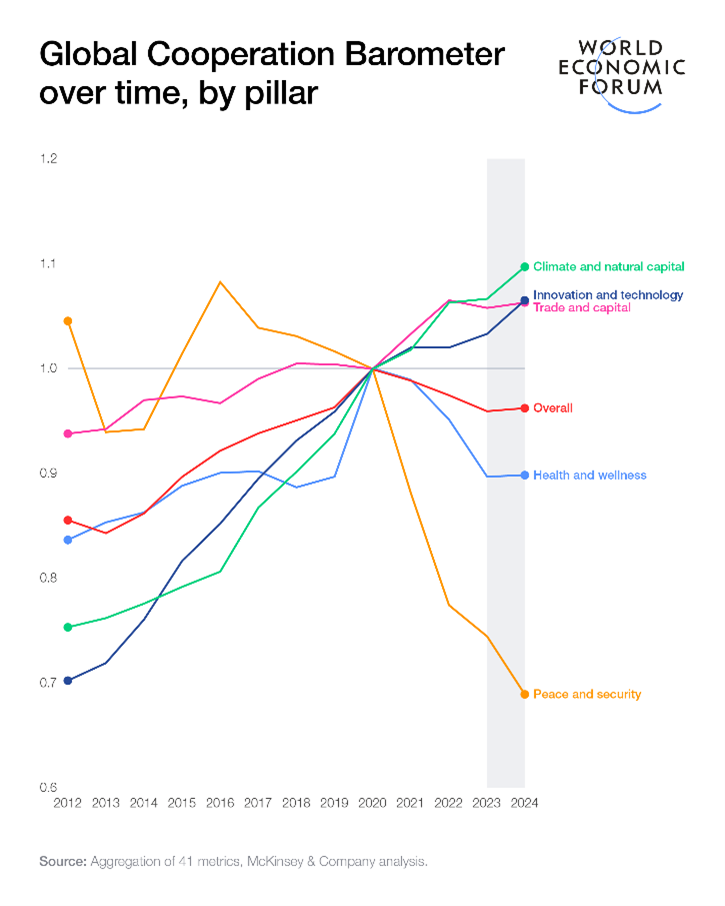
Global cooperation is reinventing itself
The changing dynamics of cooperation are visible in each of the five pillars of the Barometer.
The Global Cooperation Barometer shows countries are rewriting the way they engage in cooperation. Creating new cooperative formats will require new structures, from trade agreements to standards alliances, and new types of partnerships, including public-private and private-private, to manage them effectively. The report concludes by highlighting the need for leaders to focus on rebuilding an effective dialogue with partners as the foundation for identifying and advancing shared interests.
About the Global Cooperation Barometer
The Global Cooperation Barometer – first launched in 2024 – evaluates global collaboration across five interconnected dimensions: trade and capital; innovation and technology; climate and natural capital; health and wellness; and peace and security. The Barometer is built on 41 indicators, categorized as cooperative action metrics (evidence of tangible cooperation, such as trade volumes, capital flows, or intellectual property exchanges) and outcome metrics (broader measures of progress such as reductions in greenhouse gas emissions or improvements in life expectancy). Spanning 2012-2025 and indexed to 2020 to reflect pandemic-era shifts, the Barometer normalizes data for comparability (e.g., financial metrics relative to global GDP and migration metrics to population levels). Given rapid developments across all the areas the barometer covers, this year’s report complements the 2024 findings with more recent 2025 data where available, through partial-year data or projections. In addition, two surveys were conducted: one with around 800 executives and another with about 170 experts who are current or former members of the World Economic Forum’s Network of Global Future Councils.
