Domestic mutual funds collectively accounted for 34.34% (Rs2,784.96 crore) of the anchor book across 95 schemes. NII (HNI / Corporates)'s Allocated Amount Rs4,078.15 Cr, constituting Quota Size of 13.50%
FinTech BizNews Service
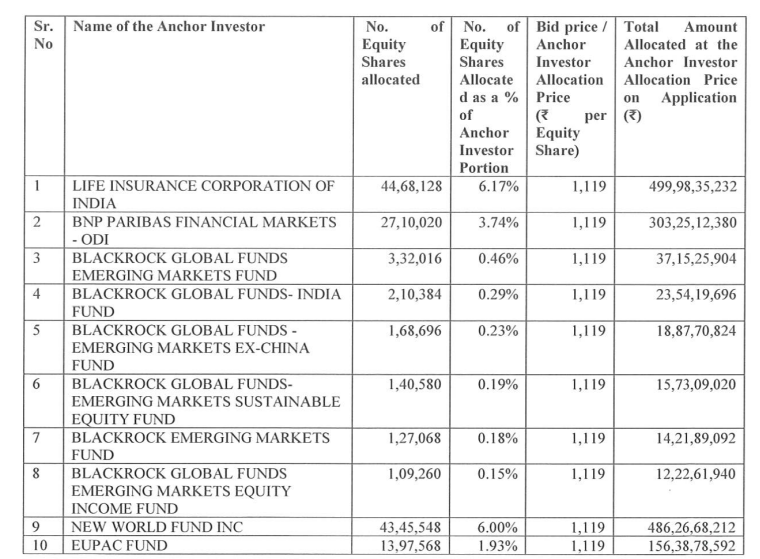
Mumbai, 20 October, 2026: Life Insurance Corporation of India (LIC) received the largest anchor allocation in the Jio Platforms IPO, followed by New World Fund Inc., the Government of Singapore (GIC), SBI Focused Fund, and BNP Paribas Financial Markets.
The Jio Platforms IPO is a Rs30,213 crore fully fresh issue of 27,00,00,000 equity shares priced at a band of Rs1,065 to Rs1,119 per share, scheduled to open on 21 Oct 2026.
The IPO Committee of the Board of Directors of the Company, at its meeting held on October 19, 2026, in consultation with the book running lead managers to the Issue, namely Kotak Mahindra Capital Company, Morgan Stanley India Company, BofA Securities India Limited, Axis Capital Limited, BNP Paribas, Citigroup Global Markets India Private Limited, CLSA India Private Limited, DAM Capital Advisors Limited, Goldman Sachs (India) Securities Private Limited, HDFC Bank Limited, HSBC Securities and Capital Markets (India) Private Limited, ICICI Securities Limited, IIFL Capital Services Limited(formerly known as IIFL Securities Limited), Jefferies India Private Limited, JM Financial Limited, J.P. Morgan India Private Limited, SBI Capital Markets Limited, UBS Securities India Private Limited and 360 ONE WAM Limited (together, "Book Running Lead Managers"), has finalized allocation of 7,24,74,066 Equity Shares, to Anchor Investors at an Anchor Investor Allocation Price of Rs1,119 per Equity Share (including a securities premium of 1,109 per Equity Share).
Top Anchor Investors & Allocations in Jio Platforms IPO
Jio Platforms raised Rs8,109.85 crore from 212 anchor investors at the upper price band of Rs1,119 per share ahead of its record IPO.
Prominent institutional allottees and leading anchor investors include:
Participating Domestic Mutual Fund Houses
Domestic mutual funds collectively accounted for 34.34% (Rs2,784.96 crore) of the anchor book across 95 schemes, while insurance and pension funds accounted for 13.44% (approx. Rs1,090 crore) across 22 accounts.
Domestic mutual funds received Rs2,784.96 crore (34.34%) of the Rs8,109.85 crore anchor book for the Jio Platforms IPO, distributed across 95 schemes managed by 25 fund houses. [
Key Allocation Highlights
Participating Domestic Mutual Fund Houses
A total of 25 fund houses participated in the anchor allotment, including:
Category-Wise Allocation & Quota Breakdown
Calculated at the upper price band of Rs1,119 per share, the institutional, non-institutional, retail, and employee reservations are structured as follows:
Category | Shares Reserved | Allocated Amount (approx.) | Quota Size (%) |
QIB (Total) | 12,14,81,893 | Rs13,593.82 Cr | 44.99% |
↳ Anchor Investors (Allocated) | 7,24,74,066 | Rs8,109.85 Cr | 26.84% |
↳ Net QIB (Ex-Anchor) | 4,90,07,827 | Rs5,483.98 Cr | 18.15% |
NII (HNI / Corporates) | 3,64,44,569 | Rs4,078.15 Cr | 13.50% |
↳ Big NII (Bids > Rs10 Lakh) | 2,42,96,380 | Rs2,718.76 Cr | 9.00% |
↳ Small NII (Bids Rs2L – Rs10L) | 1,21,48,189 | Rs1,359.38 Cr | 4.50% |
Retail Individual Investors | 8,50,37,327 | Rs9,515.68 Cr | 31.50% |
Employee Reservation | 46,94,835 | Rs525.35 Cr | 1.74% |
Total Public Issue | 27,00,00,000 | Rs30,213.00 Cr | 100% |
NII (Non-Institutional Investor) is a formal regulatory category defined by the Securities and Exchange Board of India (SEBI) for investors who apply for shares worth more than Rs2,00,000 in an Initial Public Offering (IPO) and do not fall under the Retail or Qualified Institutional Buyer (QIB) categories.
HNI (High Net-Worth Individual) is a market term used interchangeably with NII for wealthy individuals, though HNI technically describes an individual's financial wealth status rather than a formal regulatory bucket.
QIB stands for Qualified Institutional Buyer, a large, financially resilient institutional investor recognized by regulators as having the expertise and resources to invest in the capital markets without the strict regulatory protections designed for retail investors.
In India, QIBs are defined under Regulation 2(1)(ss) of the SEBI (Issue of Capital and Disclosure Requirements) Regulations, 2018. They play a major role in primary market offerings like Initial Public Offerings (IPOs) and Qualified Institutional Placements (QIPs).
In addition to the standard categories, up to Rs2,500 crore worth of shares is carved out as a specific quota for eligible Reliance Industries Limited (RIL) shareholders. Eligible employees receive a discount of Rs54 per share.
