From ‘Know Your Customer’ to ‘Know Your Product’: IRDAI Chair Outlines Consumer-Centric Reform Agenda
FinTech BizNews Service
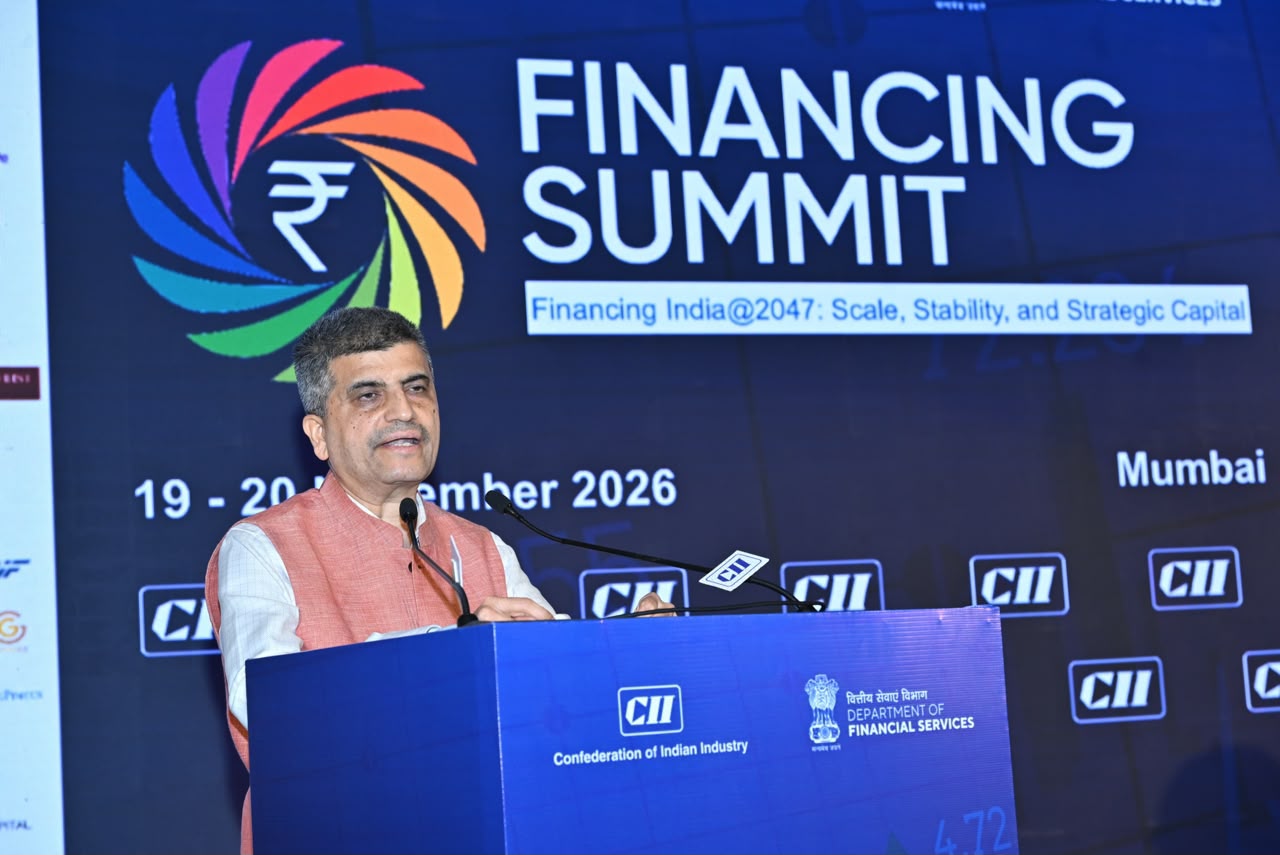
Mumbai, 19 November, 2026: The real value of an insurance policy lies not in the promise made when it is sold to the customer, but in what the policyholder receives when a claim arises, emphasised Shri Ajay Seth, Chairman, Insurance Regulatory and Development Authority of India (IRDAI). He was delivering the Standalone Keynote Address at the CII-DFS Financing Summit 2026, being held in Mumbai on 19-20 November, 2026.
Shri Seth identified three touch points that build or weaken trust between insurers and policyholders: the choice of product, the claim experience and the handling of complaints. He noted that the Statement of Objects and Reasons of the Sabka Bima Sabki Raksha Act itself recognizes the need for far-reaching reforms to expand coverage and strengthen the financial resilience.
On products, he observed that products should be made easy to read and understand, and that markets should compete on who sells best rather than who sells hardest. The central idea, he said, was that the customer should be able to see the product before the product sees the customer. He outlined four measures: access to prices without seeking personal details upfront; a plain-language summary in local languages covering scope, inclusions and returns. Further, common definitions for performance and quality should be developed with industry through subsidiary instructions; and suitability of a product should be viewed as a genuine obligation. A product which a customer can read, he noted, is a product a customer is likely to keep.
Turning to claims, Shri Seth cautioned that the claim settlement ratio, as commonly reported by count rather than amount and including partial payments and repudiations, offers little meaning to policyholders. Insurers should compete on product strength and performance, and metrics which make sense to the consumers. He pointed out that an IRDAI circular earlier this year had nudged the industry towards standardised definitions and disclosure on product performance, claim responsiveness and grievance redressal. He also flagged delays between first and last document reporting, urging insurers to communicate documentation needs clearly at the outset.
Highlighting the scale of pending litigation, he noted that around 10 lakh third-party motor accident cases are pending before tribunals, against which the industry holds reserves of about Rs 87,000 crore, with the oldest case dating back to 1989. More than 2 lakh insurance cases are also pending before consumer commissions at the district, state and national levels.
On grievances, Shri Seth said complaints should be treated as feedback to improve the service chain. Around 60 per cent of grievances reaching Bima Bharosa are resolved in favour of the policyholder on internal review, and about 60 per cent of cases before the ombudsperson are similarly decided, indicating that first-instance decisions could have been better.
He described the proposed Public Insurance Registry as an exercise in data governance with minimal centralisation, from 'know your customer' into 'know your product, know your insurer and know your distributor' for consumers.
On health insurance, Shri Seth appreciated CII's convening and analytical role over the past year in repairing the trust deficit between payers and providers. He announced that IRDAI would form two industry working groups: one on real-time visibility of claims across pre-authorisation, discharge and settlement, supported by an AI-enabled Net Promoter Score survey; and another on standardised claims and grievance metrics, including standardised rejection codes. IRDAI also intends to propose ABHA as the identity for all health insurance, including group health cover, to enable better underwriting and more competitive pricing.
Describing products, claim experience and grievance redressal as the three key aspects, Shri Seth concluded that insurance is a promise, and the test of any reform is whether that promise is kept when the customer needs it.
In his remarks, Dr Tapan Singhel, Chair, CII National Committee on Insurance & Pensions and Managing Director & CEO, Bajaj General Insurance, observed that after 'Viksit Bharat', the next national priority would be 'Surakshit Bharat'. He emphasized that simplicity of products, high-quality servicing and friction-free transparency would be essential as insurance penetration enters a phase of rapid growth.
Mr R. Mukundan, President, CII highlighted that the ambition of Insurance for ‘All by 2047’ is ultimately building a society in which households and enterprises have meaningful protection against risk, and it's a very integral part of financial security.
