Pradhan Mantri Fasal Bima Yojana: Affordable Crop Insurance for Every Farmer
FinTech BizNews Service
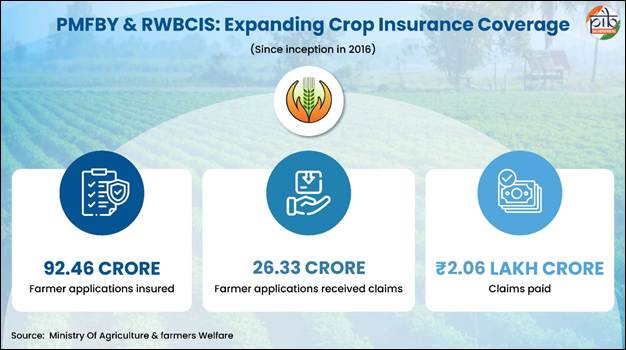
Mumbai, 29 August, 2026: Pradhan Mantri Fasal Bima Yojana (PMFBY) offers comprehensive coverage against droughts, floods, cyclones, hailstorms, pests, diseases, prevented sowing, localized calamities, damage by inundation, unseasonal rainfall, hailstorms and specified post-harvest losses nationwide. With Rs12,200 crore allocated for 2026–27, PMFBY continues strengthening farmer resilience, protecting livelihoods, stabilizing incomes, and supporting climate-resilient agriculture nationwide. In the last 10 years, since the inception of the scheme in Kharif 2016 till Rabi 2025-26, more than 92.46 crore farmer applications have been insured, and over 26.33 crore farmer applications have been paid claims exceeding Rs2.06 lakh crore. The integration of technology-driven initiatives such as the Yield Estimation System based on Technology (YES-TECH) and the Weather Information Network and Data System (WINDS) has further strengthened the scheme by enabling faster, fairer, and more transparent claim settlement.
Digital Innovations Strengthening Crop Insurance Delivery
PMFBY’s digital platform integrates farmers, insurers, financial institutions, and government agencies on a single IT ecosystem. It enables real-time information sharing, transparent administration, and streamlined crop insurance services. The portal digitizes area, crop, and scheme notifications, reduces manual processes, and improves access to insurance, particularly for remote and economically vulnerable farmers.
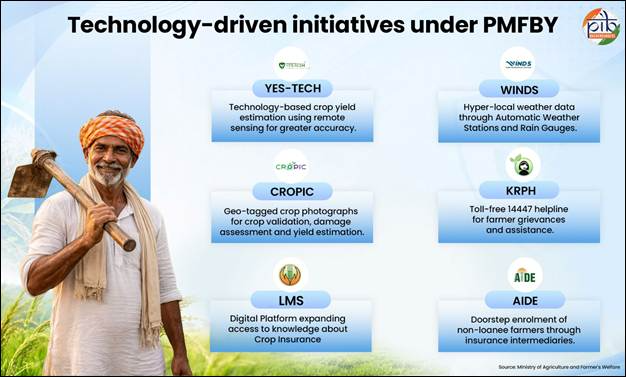
These technology interventions transformed PMFBY by enabling faster enrolment, accurate loss assessment, timely claim settlement, and effective grievance redressal for farmers.
Securing Rural Livelihoods Through Crop Insurance
Crop insurance protects farmers from crop losses caused by natural calamities, adverse weather, pests, and diseases. Timely compensation helps farmers manage income shocks, recover losses, repay loans, and invest in the next cropping season. It strengthens farm resilience, safeguards livelihoods, and supports continuity of agricultural production during uncertain conditions.
On 18 February 2016, the Pradhan Mantri Fasal Bima Yojana (PMFBY) was launched to bring the maximum number of farmers under crop insurance coverage. It covers risks from pre-sowing, including prevented or failed sowing, widespread mid-season adversity, localized calamities caused by hailstorms, inundation, landslide, etc., at individual land parcels, to post-harvest losses caused by cyclones, unseasonal rains, and other specified perils. Premium rates remain low and affordable to encourage wider farmer participation. The Government has allocated Rs12,200 crore for PMFBY in the Union Budget 2026–27, reinforcing its continued commitment to crop insurance and farmer coverage.
PMFBY in Action: A Farmer’s Story of Resilience
Anwar Hussain, a small farmer from Chankhala village in Assam’s Nagaon district, depends entirely on agriculture for his family’s livelihood. When heavy rains severely damaged his crop, he faced uncertainty over repaying his loans and financing the next sowing.
Fortunately, Anwar had enrolled under the Pradhan Mantri Fasal Bima Yojana (PMFBY) by paying a nominal premium of just Rs 100. After the crop loss was assessed, he received Rs50,600 in compensation under the scheme. This timely financial support helped him recover from the loss, repay part of his debt, and invest in inputs for the next season. With this support, Anwar was able to continue farming with renewed confidence instead of falling into financial distress. Today, he strongly encourages other farmers in his village to insure their crops, saying that PMFBY acts as a safety net during times of crisis.
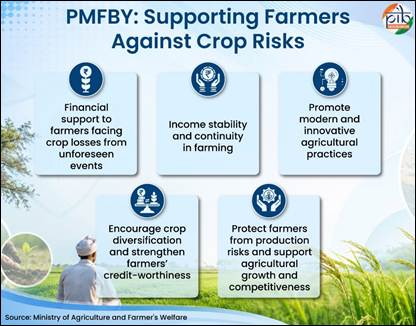
PMFBY provides financial coverage against crop losses and helps stabilise farmers’ incomes. It also promotes modern farming practices, crop diversification, and resilience against production risks.
Inclusive Coverage of Farmers
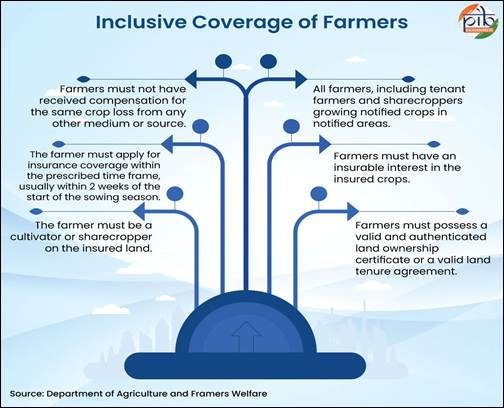
PMFBY provides inclusive crop insurance coverage to farmers, including tenant farmers and sharecroppers, subject to prescribed eligibility conditions. Farmers must have an insurable interest, valid land documents or tenure agreements or sowing certificates as per state-specific pre-defined requirements, and apply within the specified timeframe. To ensure inclusive risk coverage, PMFBY covers both loanee and non-loanee farmers across the agricultural range.
Risks Covered
PMFBY provides coverage against crop losses at different stages of cultivation and harvesting:
However, PMFBY excludes losses from war, nuclear risks, riots, theft, specified post-harvest conditions, and other preventable risks.
Progress and Achievements Under PMFBY
PMFBY has witnessed significant expansion in farmer participation, insurance coverage, and institutional reach in recent years. Farmers pay a maximum premium of 2% for Kharif and 1.5% for Rabi foodgrain and oilseed crops. For commercial and horticultural crops, the maximum premium is 5%. The Central & State Governments subsidizes the remaining premium in 50:50 proportion. For the farmers in North-Eastern & Himalayan States/UTs, the contribution of Central & State Govt. subsidy is in a 90:10 proportion. This affordable premium structure has helped make crop insurance accessible to a wider section of farmers across the length and breadth of the country.
State-Specific Progress and Insights
Rejoining of Major States Reflects Growing Confidence
The confidence of State Governments in the PMFBY framework has grown significantly, as evidenced by the systematic return of major agricultural states that had previously opted out or launched their own non-insurance crop relief schemes.
This wave of returns highlights the unmatched efficiency and financial safety net that the centralized scheme offers compared to regional non-insurance relief models.
Impact of Universalisation Discontinuation in Maharashtra and Andhra Pradesh:
A detailed look at regional enrollment trends reveals that the moderate national dip in insured farmer applications during the 2025–26 season is concentrated primarily in Maharashtra and Andhra Pradesh, owing to a change in implementation methodology rather than indicating any broad decline in farmer trust in the scheme.
Steady and Strong Growth in Other Major States
In stark contrast to these state-specific, localized policy-driven adjustments, other major agricultural states recorded highly robust growth in farmer enrollment during Kharif 2025:
These consistent positive double-digit trends demonstrate the strong, self-motivated demand for agricultural risk coverage across India's primary farming belts.
Key Government Initiatives to Strengthen PMFBY Implementation
PMFBY is being implemented through a robust digital and governance framework that ensures transparent, timely, and accurate crop insurance services.
Restructured Weather-Based Crop Insurance Scheme (RWBCIS)
Complementing PMFBY, the Government implements the Restructured Weather-Based Crop Insurance Scheme (RWBCIS) to address risks arising specifically from adverse weather conditions. RWBCIS is a weather index-based scheme where admissible claims are determined using specified weather parameters as a "proxy" for crop damage rather than actual assessed crop-yield losses. Under this scheme, a crop’s life cycle is divided into distinct phenological phases, with the sum insured allocated based on the crop's vulnerability during each phase.
The scheme operates on an "Area Approach" in defined Reference Unit Areas (RUAs). Payouts are triggered when quantifiable weather variables—including deficit or excess rainfall, dry spells, extreme temperatures, humidity, and wind speed-measured at notified local weather stations deviate from pre-defined thresholds. States/UTs can also offer add-on farm-level coverage for severe localized perils such as hailstorms and cloudbursts. Sharing the same affordable premium rates as PMFBY (1.5% to 5% depending on crop type), RWBCIS remains a highly popular safety net, especially for Fruit, Vegetables, and Plantation crops, covering 25.95 lakh farmer applications covering 12.31 lakh hectares in Kharif 2026.
Transforming Agricultural Risk Management through PMFBY
Over the past decade, the Pradhan Mantri Fasal Bima Yojana (PMFBY) has emerged as a cornerstone of India’s agricultural risk management framework. It provides millions of farmers with financial security against climate change, extreme weather events, and biological risks. By combining affordable premiums with comprehensive crop-cycle coverage, the scheme has reduced farmers’ vulnerability to income shocks. It has also strengthened their ability to invest in modern inputs, improved seeds, and better farming practices.
Digital platforms & interventions such as NCIP, DigiClaim, CCE Agri App, CLAP, YES-TECH, and WINDS improved transparency, accuracy, and speed of claim settlement under PMFBY. These technologies also made PMFBY more efficient and accountable. As India moves towards climate-resilient agriculture, PMFBY stands well-positioned to continue safeguarding farmers’ livelihoods, fostering resilience in agriculture, and strengthening national food security in the years ahead.
References
Ministry of Agriculture and Farmers Welfare
https://pmfby.gov.in/pdf/New%20Schemes-english_.pdf
https://agriwelfare.gov.in/en/CropInsurance
https://www.myscheme.gov.in/schemes/pmfby
https://agriwelfare.gov.in/en/CropInsurance
https://www.pib.gov.in/PressReleseDetail.aspx?PRID=2097959®=3&lang=1
https://www.pib.gov.in/PressReleasePage.aspx?PRID=2089250®=3&lang=2
https://www.pib.gov.in/PressReleasePage.aspx?PRID=2148513®=3&lang=2
Microsoft Word - lu431
https://sansad.in/getFile/loksabhaquestions/annex/186/AU1610_Vz2gT8.pdf?source=pqals
https://sansad.in/getFile/loksabhaquestions/annex/184/AU269_UCTI1z.pdf?source=pqals
https://sansad.in/getFile/loksabhaquestions/annex/186/AU2752_K8yh1l.pdf?source=pqalshttps://sansad.in/getFile/loksabhaquestions/annex/186/AU2582_mUayeg.pdf?source=pqals
https://sansad.in/getFile/loksabhaquestions/annex/186/AU2608_FGMVt9.pdf?source=pqals
https://sansad.in/getFile/loksabhaquestions/annex/187/AU496_DO5aVo.pdf?source=pqals
https://sansad.in/getFile/loksabhaquestions/annex/184/AU431_EwtiAQ.pdf?source=pqals
https://sansad.in/getFile/loksabhaquestions/annex/184/AU431_EwtiAQ.pdf?source=pqalsHhttps://www.myscheme.gov.in/schemes/pmfby
https://www.pib.gov.in/PressReleasePage.aspx?PRID=2004173®=48&lang=2
https://agriwelfare.gov.in/en/CropInsurance
https://pmfby.gov.in/pdf/New%20Schemes-english_.pdf
https://sansad.in/getFile/loksabhaquestions/annex/186/AU2582_mUayeg.pdf?source=pqals
https://pmfby.gov.in/adminStatistics/dashboard
https://pmfby.gov.in/aboutUs
https://pmfby.gov.in/pdf/RWBCIS_Revised_Guidelines_1.pdf
Ministry of Finance
https://www.indiabudget.gov.in/doc/eb/allsbe.pdf
Success Story
https://www.youtube.com/watch?v=sXEjHod1ltY
