Accenture’s Results Provide No Solace To A Sector Plagued By Multiple Headwinds
FinTech BizNews Service
Mumbai, 22 June 2026: The latest Kotak Institutional Equities report on IT Services provide useful insights: .
Accenture reported muted numbers on revenue growth (midpoint of guidance), FY2026 guidance (cut to 3-4% from 4-5% earlier) and bookings (yoy decline with managed services book-to-bill lesser than 1). Incremental headwinds from the Middle East conflict, client-specific issues and continued pressure in discretionary spends, all played a role. Commentary on higher AI adoption by clients is encouraging, but is not reflected in numbers as of now. Expensive acquisitions and move to tap the mid-market segment may point to low confidence in a quick recovery in the existing market.
Revenue growth at the midpoint of guidance
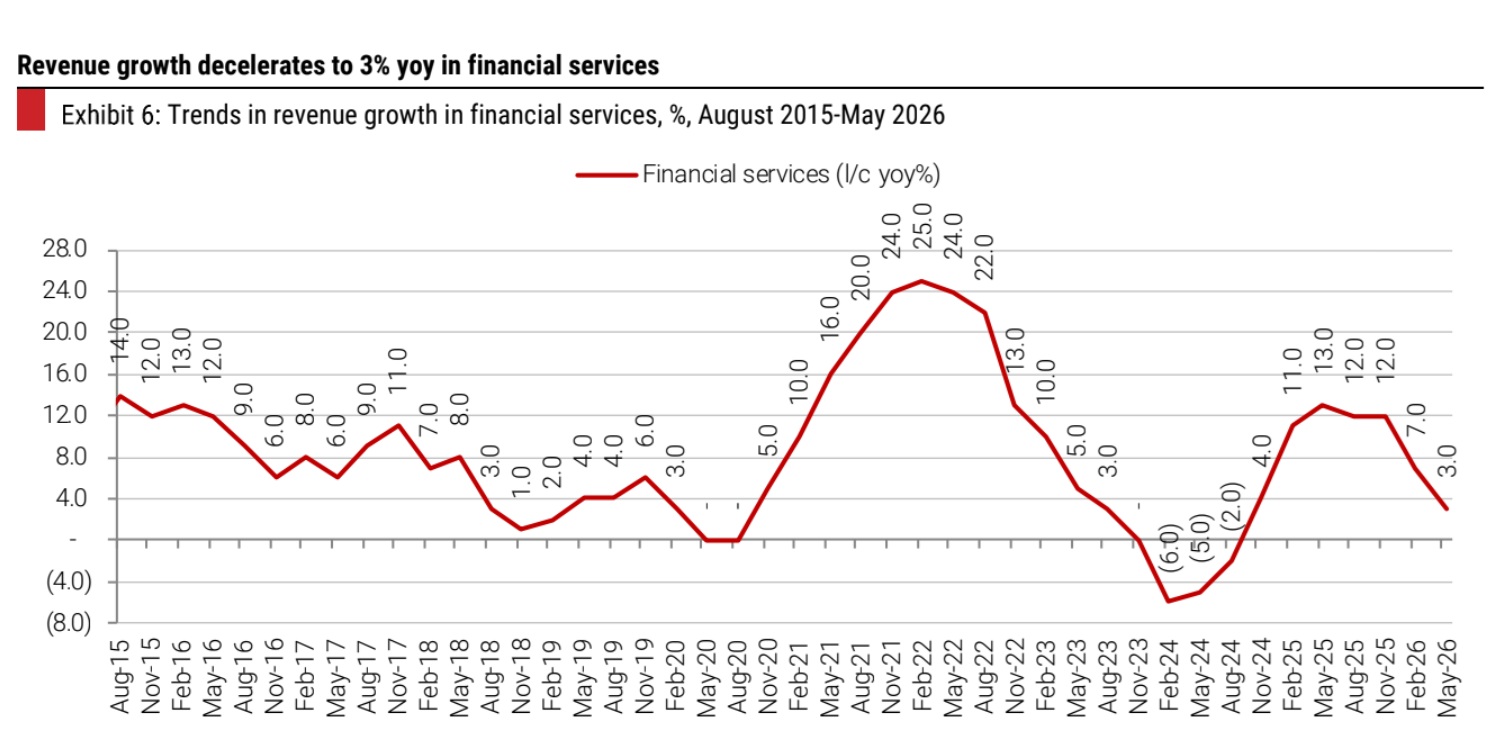
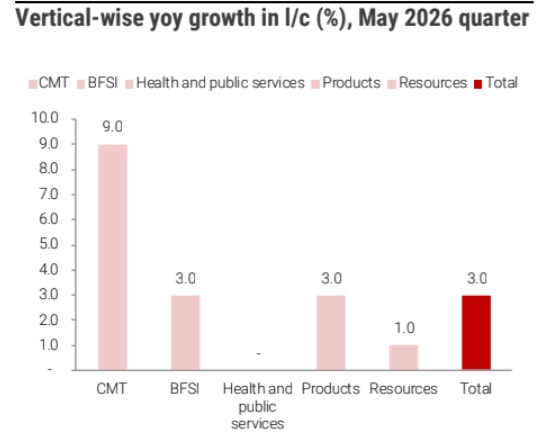
Accenture reported revenue of US$18.7 bn, which grew 5.6% yoy in US$ terms and 3% in local currency. Revenue growth was at the midpoint of its 1-5% guidance. Managed services grew 5% yoy in local currency, while consulting grew 1%. Among geos, yoy growth was led by APAC (8%) and EMEA (4%), while Americas was weak at 1%. Among verticals, yoy growth was led by telecom and tech vertical (9%), while others grew at 0-3%.
The Middle East conflict contributes to incremental demand headwinds
The Middle East conflict had a revenue impact of US$100 mn in 3QFY26, evenly split across direct impact on the Middle Eastern business and indirect impact, especially in select verticals such as products and to a lesser degree in the resources vertical. The impact was largely on consulting-related services. Longer decision-making due to the war scenario led to sales delays in the Middle East and the EMEA. Several large deal opportunities slipped into FY2027 due to client-specific reasons. Discretionary spend remains under pressure.
FY2026 growth guidance cut to 3-4% from 3-5% earlier
Accenture guided for 1-5% yoy growth in 4QFY26 and cut annual guidance to 3-4%. Inorganic growth contribution remains at ~1.5% in FY2026. Impact of the Middle East conflict on demand will continue in 4QFY26. On the other hand, the US Federal business will grow in 4QFY26 yoy following the anniversary of the revenue decline. Inorganic contribution will be ~2%. Hence, the midpoint of the guidance essentially implies nil organic growth, excluding the US Federal business.
Sharp yoy decline in managed services bookings
Bookings of US$19.3 bn declined 3% in local currency, driven by a 15% yoy decline in US$ terms in managed services, even as consulting bookings increased 13% yoy. The decline in bookings was led by longer decision-making by clients due to the Middle East conflict and slippage of a couple of deals into FY2027 due to client-specific reasons. The number of US$100 mn+ deals declined 11 qoq and was flat yoy at 30. Notably, Accenture’s book-to-bill in managed services declined below 1X in 3QFY26.
Read-through for Indian IT—no positive cues
Accenture’s results provide no solace to a sector beleaguered by multiple headwinds and the risk of higher AI deflation from sharp GenAI capability increase in software tasks. We identify three inferences, i.e., (1) incremental headwinds to growth led by the Middle East conflict, with indirect impact focused more on discretionary spending and product vertical; Infosys can be a tad more vulnerable than Tier 1 peers to indirect impact, (2) the possibility of the lack of sufficiently managed services opportunities in the market and (3) growth moderation in the existing services market may not recover soon as Accenture looks to expand TAM by targeting mid-market enterprises and using expensive acquisitions to move into new high-growth areas.
Expensive acquisitions and mid-market focus—strategic moves or acts of desperation?
Accenture announced the acquisition of three companies (majority stake in Dragos and 100% stake in runZero and NetRise) in the cybersecurity domain for a combined consideration of US$4.2 bn at ~20X ARR. Acquisitions have a US$208 mn ARR, as of June 2026, growing at 53% yoy. The acquisitions are a bet on elevated OT cybersecurity demand as enterprises scale up the adoption of physical AI. The acquisitions have strong gross margins. Acquisitions will be earnings dilutive initially, but are expected to become accretive to earnings and FCF over time.
Accenture has also taken a few other expensive bets recently, including the acquisition of (1) UK AI firm faculty for ~US$1 bn, according to media reports, (2) Ookla and its suite of connectivity brands for US$1.2 bn and (3) Alfahealth and Industries eXcellence for ~US$1 bn, according to media reports. These acquisitions together will drive a sharp increase in spend on acquisitions to ~US$9 bn in FY2026E for Accenture.
These and other similar acquisitions serve a few purposes for Accenture—(1) help ride the AI wave by strengthening expertise in AI services and AI adjacent services, (2) increase exposure to platform + services revenue model and (3) increase TAM. In another move to increase TAM, Accenture announced Accenture Edge, a new business unit, which will focus on addressing demand in the midmarket segment.
On one hand, these moves can be viewed as strategic with a focus on capturing new opportunities, driven by AI adoption. On the other hand, the expensive nature of acquisitions and focus on midmarket enterprises, not the typical focus area for a large services firm, also raises the question of whether these are desperate measures taken in an increasingly tougher and competitive IT services market.
AI adoption continues to increase among enterprises
Clients continue to invest in the foundations needed to scale AI. This includes strengthening their digital core through cloud, data, security and operating model transformation. At least one out of every two advanced AI projects is continuing to lead to a data project for Accenture. Clients are moving from pilots to production. Clients with more advanced digital cores are moving to larger AI transformation programs. These are complex and require deep industry and functional knowledge in addition to technology and AI expertise. In 3QFY26, an incremental 100 clients initiated advanced AI projects with Accenture. The company is on track to double bookings from key emerging AI and data partners in FY2026 compared with the previous year. AI projects are small but there has been a steady increase in the average size.
Highlights from earnings call
4 | Demand impact. (1) The Middle East conflict. The US$100 mn revenue impact split evenly between the direct impact on the Middle Eastern business and indirect effects outside the region. The impact was entirely in consulting-related services. In the past few weeks of 3QFY26, the products vertical (and to a lesser degree the resources vertical) faced the indirect impact from the war, mostly on discretionary spending. Bookings to the extent of US$400 mn were impacted in the Middle East. Longer decision-making also impacted bookings in EMEA. (2) Slippage in deals. A couple of large managed services opportunities slipped to FY2027 due to client-specific reasons. |
4 | Accenture Edge. This business will embed Accenture's large enterprise expertise and ecosystem relationships in business solutions designed specifically for the mid-market. These companies need solutions that are faster to deploy, more repeatable and the right size for their scale. Clients in the mid-market do not require as much coverage for large enterprises. Penetration into the mid-market segment can ease pressure from a tough discretionary spending environment. |
4 | Acquisitions. Accenture expects to spend US$9 bn on M&A in FY2026. The company has spent ~US$3 bn on 13 acquisitions in 9MFY26. Accenture continues to have a pipeline of attractive acquisition targets for FY2027. Accenture’s acquisitions in the OT cybersecurity space will be critical or enterprise adoption of physical AI. Recent acquisitions in cybersecurity, Ookla and AlfaHealth have services and platform combination and will help drive an increase in the non-FTE based revenue. |
4 | Managed services. Managed services grew 5% yoy in local currency, driven by mid-single-digit growth in technology and high single-digit growth in operations. Clients are demanding more consulting and AI expertise in managed services. This is driving more consulting work and large managed services programs. |
4 | Geo-based growth. Americas grew 3%, excluding the impact from the US Fed business. Growth was led by software and platforms, hi-tech and industrials. EMEA grew 4%, driven by growth in public service and software and platforms. Revenue growth was driven by the UK and Italy, partially offset by the decline in Germany and the Middle East. In APAC, revenue grew 8%, driven by public services and BFSI. Growth was driven by Japan, Australia and Singapore. |
4 | Inorganic growth. Continues to expect 1.5% inorganic growth in FY2026. |
4 | The Middle East conflict. Accenture expects more indirect impact of the war in 4QFY26, especially in discretionary spends. Indirect impact is being felt in automotive due to higher oil prices. |
4 | Deal wins. A couple of deals slipped into FY2027 for client-specific reasons. These are large managed services deals. |
4 | 4QFY26 growth considerations. US Federal services impact will sunset and the business will return to growth in 4QFY26. Inorganic growth will be slightly less than 2% as Accenture enters FY2027. |
4 | Helping clients optimize token costs. Similar to FinOps practice, which optimizes cloud usage. Accenture will help clients reduce spends on tokens and can drive AI RoI for clients. Token spending by enterprises will not significantly impact spending on services and will lead to higher services demand over a period of time. |
4 | Large deals. Had 30 clients with bookings greater than US$100 mn+ in 3QFY26. |
4 | Promotions. 124k employees were promoted, a 30% increase yoy. |
