Tech Costs for Indian Banks Up 6X Since FY15
FinTech BizNews Service
Mumbai, 12 August, 2026: India's banking sector must sustain asset growth 3.5 to 4 percentage points above nominal GDP over the next two decades to underpin a USD 30 trillion economy by 2047, according to ‘Winning in the AI Era: The New Playbook for Indian Banks’, released by FICCI, Boston Consulting Group (BCG) and the Indian Banks' Association at FIBAC 2026.
The report estimates that such a trajectory would require banking assets of roughly USD 45 trillion by 2047, lifting the banking-assets-to-GDP multiple from 0.9x in FY25 to a 1.5x aspiration. India currently trails China at 2.8x, the euro zone at 2.0x and the United States at 1.1x. The gap is beginning to close: bank assets expanded by 12.4 per cent in FY26 against nominal GDP growth of 8.9 per cent, a 3.5 percentage-point margin, compared with just 0.2 percentage points over the FY15-25 decade.
The sector enters the transition from a position of strength. The share of bank equity trading above tangible book value globally excluding China rose from 52 per cent in June 2022 to 81 per cent in January 2026; for India, the figure climbed from 63 per cent to 95 per cent. Indian banks generated excess returns over the cost of equity of 3.0 per cent in FY26, ahead of the United States at 0.5 per cent and China at 0.1 per cent, while Japan and South Korea recorded minus 5.7 per cent.
The report finds that a decade of digitisation has yet to deliver the expected productivity gains at scale. Technology costs for Indian banks have risen 6.1 times since FY15, an 18 per cent compound annual rate, yet the industry cost-to-income ratio has barely moved, from 47.3 per cent to 48.6 per cent. Recent years, however, are showing signs of a shift from capacity-led growth towards tangible productivity gains.
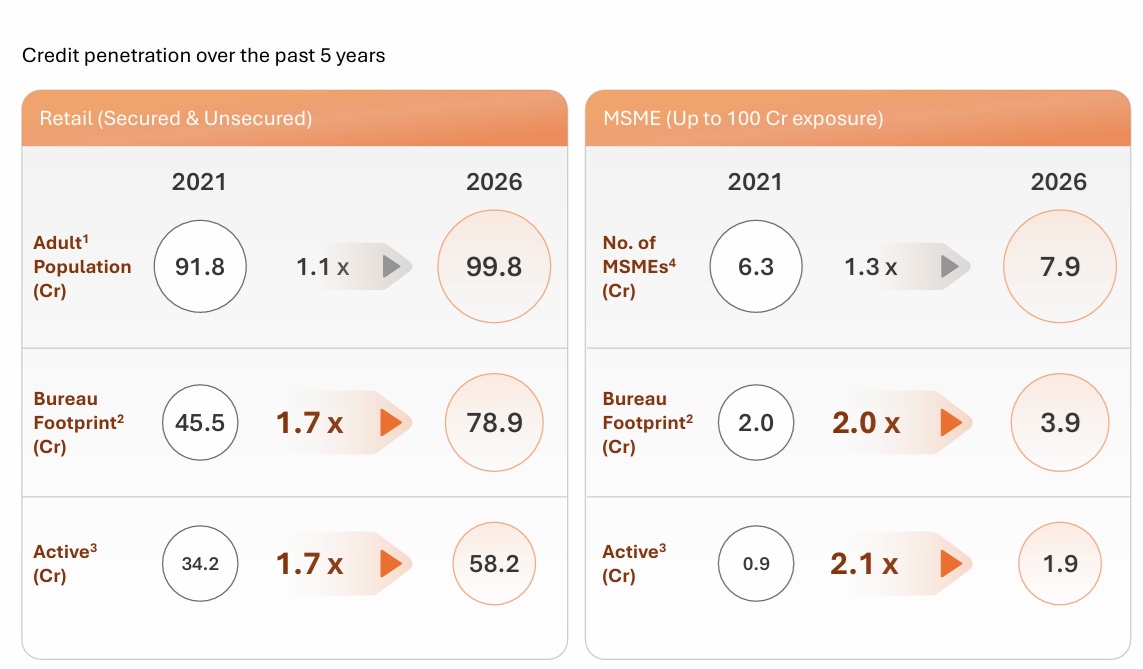
Credit access has widened sharply — the retail bureau footprint grew by 1.7 times in five years to 78.9 crore, while the MSME footprint doubled to 3.9 crore — but affordability has not kept pace. Operations and collections together account for 40 to 50 per cent of the cost to serve, exceeding credit losses. Agentic credit journeys, the report argues, could cut turnaround times by 50-90 per cent and operating expenditure by 40-60 per cent, while shifting collections to lower-cost digital channels could reduce collections costs from 20–25 per cent to 10–15 per cent of operating expenditure.
Adoption is accelerating without yet being strategic. The share of banks with generative AI use cases under implementation rose ninefold, from 10 per cent in 2024 to 86 per cent in 2026, but only 36 per cent rank the technology among their top three priorities, against 81 per cent of Indian CXOs across sectors. Data and infrastructure readiness was cited as the leading obstacle by 77 per cent of respondents.
Risk exposure is widening in parallel. Indian BFSI organisations face 1.6 times the global average of attacks per organisation, while the interval from vulnerability disclosure to first observed exploitation has compressed seventeen-fold. Only 38 per cent of Indian BFSI firms devote more than a tenth of their IT budget to cybersecurity, compared with 76 per cent globally.
The fraud risk in retail credit remains stubbornly high and much greater efforts are needed by lenders to enhance fraud risk management capability at the same level as credit risk management capability. Banks need to strengthen resilience beyond traditional credit risk, with greater focus on fraud, operational resilience, cybersecurity, geopolitical and climate risks.
The report closes with a 13-point agenda across banks, regulators and government, including a third- and fourth-party registry for AI/GenAI vendors, a regulatory sandbox for AI/GenAI vendors and use cases, and a public-private partnership between banks, utilities and CERT-In for real-time detection and dissemination, and to strengthen collective response and recovery.
