FM Unveils User-Friendly Income Tax Website 2.0

FinTech BizNews Service
Mumbai, March 20, 2026: Union Minister for Finance and Corporate Affairs Smt. Nirmala Sitharaman launched ‘PRARAMBH 2026’ — Income Tax Department’s nationwide awareness campaign on Income Tax Act, 2025, in New Delhi, today. This multimedia initiative, spanning print, radio, television, outdoor, digital and social media, has been designed to build awareness about the key features of the new Act, which is set to come into effect from 01.04.2026.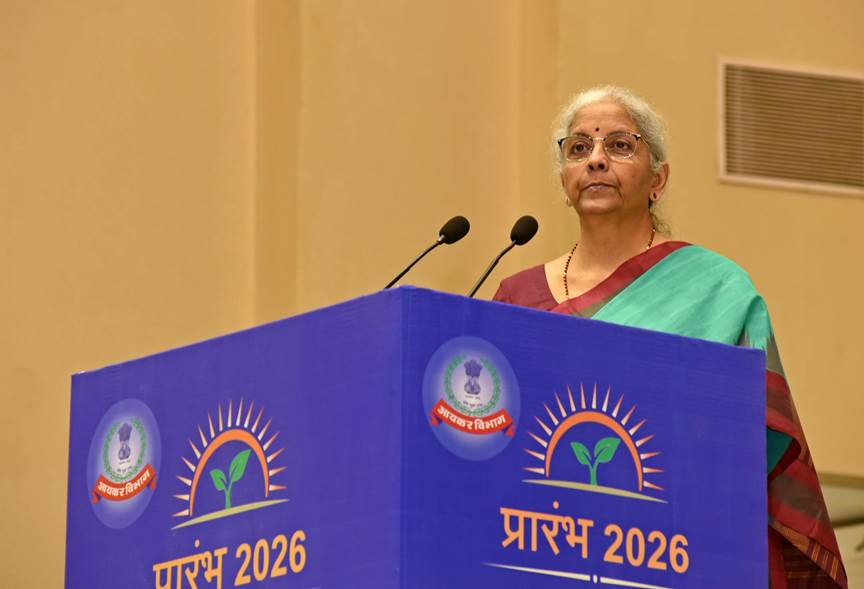
The campaign includes creative communication initiatives, taxpayer guidance material such as guidance notes, tutorial videos and brochures, and extensive public engagement through digital and on-ground platforms, including the MyGov Quiz initiative.
The Union Finance Minister also inaugurated the Income Tax Website 2.0 as part of the Department’s ongoing digital transformation efforts. The upgraded platform is designed to offer improved usability, simpler navigation, and more efficient service delivery for taxpayers.
Also present on the occasion were Shri Arvind Shrivastava, Secretary, Department of Revenue, Ministry of Finance; Shri Ravi Agrawal, Chairman, Central Board of Direct Taxes (CBDT), Shri Vivek Chaturvedi, Chairman, Central Board of Indirect Taxes and Customs (CBIC); Members of CBDT and CBIC Boards, and other officers and officials of the Department.
In her keynote address, Smt. Sitharaman traced the journey of the passing of the Income Tax Act, 1961 in Parliament, highlighting the extraordinary efforts of officers across the Department of Revenue during the year.
The Union Finance Minister noted that CBDT’s initiatives, including those under “PRARAMBH,” focus on simplifying income tax, with a strong emphasis on taxpayer service. In a first for independent India, both direct and indirect tax systems are being overhauled simultaneously, reflecting a shift toward a more citizen-centric and outreach-oriented administration. Smt. Sitharaman highlighted that the new Act, developed through extensive effort and broad consultation, recasts provisions with greater clarity and aims to reduce disputes, improve compliance, and shift behaviour from confusion and avoidance to acceptance and trust.
Stressing on the effective implementation of the Act as that is important as the law itself, the Union Finance Minister observed that the tax officers represent the government to taxpayers and must adopt an empathetic, trust-based approach, leveraging technology to reduce human interface while maintaining a humane touch.
Appreciating that the Income Tax Department is undertaking a multi-lingual outreach and communicating in simple language while using digital platforms effectively, Smt. Sitharaman emphasised on the need for engaging with youth and professionals, including collaboration with institutions for AI-driven solutions.
The Union Finance Minister recalled Prime Minister Shri Narendra Modi’s vision, which he presented during the AI Summit held in New Delhi, to have a human-centric digital era through M.A.N.A.V.:
M: Moral and Ethical Systems
A: Accountable Governance
N: National Sovereignty
A: Accessible and Inclusive AI
V: Valid and Legitimate Systems
Citing the vision of the Prime Minister, Smt. Sitharaman reiterated that Income Tax Act, 2025 must be rooted in moral and ethical systems.
The Union Finance Minister concluded her address by cautioning against repeating past patterns of excessive amendments, and observed that the new law must remain stable, simple, and comprehensible, supported by human-centric use of technology, as the ultimate objective is to create a system where compliance becomes the natural choice, driven by ease, clarity, and trust.
In his address, Revenue Secretary Shri Arvind Shrivastava observed that the Income-tax Act, 2025, represents not merely a new law but a deliberate shift towards a simpler, clearer, and more user-friendly tax system. He noted that alongside aligning Rules and Forms, the Department has focused on extensive capacity-building to ensure officers across the country are well-prepared to support taxpayers, recognising importance of on-ground implementation.
Shri Shrivastava noted the significant efforts being made by the Department to enhance accessibility of information through FAQs, brochures, guidance notes, and regional language resources, and observed that the communication strategies have evolved to be more relatable, leveraging digital platforms through short videos to meet taxpayers in familiar formats.
Shri Shrivastava also emphasised on the importance of fostering early awareness through educational content for students and said that the nationwide outreach campaign, including over 300 workshops, will not only disseminate information but also actively seek stakeholder feedback, reinforcing this reform as an ongoing dialogue rather than a one-way communication.
Noting the scale of this outreach initiative, Shri Shrivastava observed that PRARAMBH 2026 is not just a launch, but the beginning of a more open, responsive, and simplified tax ecosystem.
Earlier in his welcome address, Shri Ravi Agrawal, Chairman, CBDT, stated that PRARAMBH (Policy Reform and Responsible Action for Mission Viksit Bharat) is guided by the spirit of Nagrik Devo Bhava, and highlighted that the Income Tax Act, 2025, marks an important step in India’s tax administration journey and must be implemented in a smooth and taxpayer-friendly manner.
Shri Agrawal explained that PRARAMBH has been conceived as a nationwide outreach and facilitation initiative to ensure clear, accessible and reassuring communication through multilingual campaigns, educational content, digital tools, extensive FAQs and guidance material to ease compliance, and phased system enablement.
He also announced the launch of AI-enabled chatbot Kar Saathi, an easy-to-approach companion for taxpayers seeking information on the new Act, Rules, Forms and related queries, and underlined that support will remain available through Aaykar Seva Kendras as well, reflecting the Department’s commitment to citizen-centric, technology-enabled and empathetic tax administration.
Shri Sanjay Bahadur, Member (IT), CBDT gave an overview of the content rollout during PRARAMBH including brochures, FAQs and MyGov Quiz initiative.
The programme further featured a report by Shri Prasenjit Singh, Member (Legislation), CBDT on thematic sessions conducted with stakeholders. It was followed by feedback of various stakeholders from the thematic sessions.
The event concluded with a vote of thanks by Smt. G Aparna Rao, Member (Taxpayer Services & Revenue), CBDT.
Prarambh 2026 reflects the Income Tax Department’s continued commitment to modernisation, stakeholder engagement, and citizen-centric governance, as it prepares for the effective implementation of the Income Tax Act, 2025.
