8,58,000 cooperative societies across 30 sectors and 32 crore members are now available together in one database.
FinTech BizNews Service
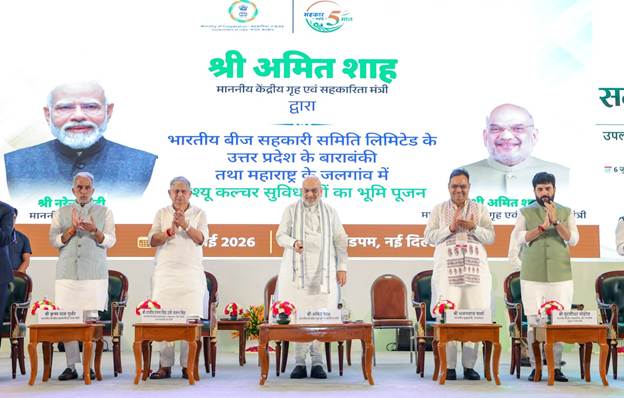
Mumbai, July 6, 2026: Union Home Minister and Minister of Cooperation Shri Amit Shah addressed the 5th Foundation Day celebration of the Ministry of Cooperation in New Delhi today. Union Minister of Fisheries, Animal Husbandry and Dairying Shri Rajiv Ranjan Singh alias Lalan Singh, Chief Minister of Rajasthan Shri Bhajan Lal Sharma, Union Ministers of State for Cooperation Shri Krishan Pal Gurjar and Shri Murlidhar Mohol, Chief Secretary of Rajasthan Shri V. Srinivas, Secretary, Ministry of Cooperation Dr. Ashish Kumar Bhutani, Secretary, Ministry of Agriculture and Farmers Welfare Shri Atish Chandra, Secretary, Department of Animal Husbandry and Dairying Shri Naresh Pal Gangwar and several senior officials were present on the occasion. National cooperative institutions, cooperative federations, cooperative banks, dairy cooperatives, Bharat Taxi, PACS and other stakeholders from the cooperative sector also participated in the programme.
On the occasion, Union Home Minister and Minister of Cooperation Shri Amit Shah said that today is an extremely auspicious day for all of us. Exactly five years ago, the 75-year-long wait of 32 crore people associated with cooperation and more than 8.50 lakh cooperative institutions across the country came to an end. On this very day, Prime Minister Shri Narendra Modi took the historic decision to establish an independent Ministry of Cooperation in the Government of India. He said this decision of the Prime Minister pivoted the country’s cooperative movement to new heights, which had remained neglected and was subjected to second-class treatment for 75 years before that. He said that by establishing the Ministry of Cooperation, Modi ji infused new life into the cooperative sector.
The Union Home Minister and Minister of Cooperation said that whenever our party or alliance got the opportunity to govern, we gave special emphasis to, rural development and all sectors related to agriculture. He said when Atal ji became Prime Minister, he established the Ministry of Tribal Affairs. In 2019, Modi ji established the Ministry of Jal Shakti, bringing water management under one integrated ministry. In the same year, the Ministry of Fisheries was created. That year itself, the Ministry of Animal Husbandry and Dairying was established separately, and in 2021, by creating the Ministry of Cooperation, Modi ji took a major revolutionary step in the field of agriculture and rural development.
Union Minister of Cooperation Shri Amit Shah said that when the Ministry of Cooperation was established five years ago, the biggest controversy created was that ‘cooperation’ is a State subject under the Constitution of India and that by forming a Ministry of Cooperation at the Centre, the Union Government would interfere in the work of States. He said five years have passed, but even States governed by opposition parties have never complained that the Union Ministry of Cooperation is interfering in any way, and this is our biggest achievement. He said those who understand cooperation know that there can be no question of interference in cooperation. Taking everyone along, moving forward with everyone’s cooperation and continuously adding everyone’s strengths is the very essence of cooperation. He said that in the last five years, the Ministry of Cooperation has proved that it was created not to interfere in the functioning of the States, but to assist them, to support policy-making and to help in their advancement. Shri Shah said the Ministry of Cooperation has initiated several steps that have completely proved wrong the assumptions of those with a negative mindset.
Shri Amit Shah said that in these five years, we have identified problems, nurtured possibilities and also provided future-oriented policies to States. He said the last five years have proved to be a golden period for the Ministry of Cooperation. Whenever the history of India’s cooperative movement is written, this period will certainly be recorded in golden letters. He said that from PACS to apex institutions, from State Governments to cooperative federations at the district level, we have converted our initiatives into results after extensive consultation at every level.
Union Home Minister and Minister of Cooperation Shri Amit Shah said that for 62 years, the work of cooperation was handled under the Ministry of Agriculture merely at the level of a Joint Secretary. Today, a fully independent Ministry of Cooperation is moving forward by taking all States and 8.30 lakh cooperative societies across the country along. He said that in the last five years, we have not only achieved several milestones, but have also worked to make our cooperative system modern, transparent, technologically enabled and competitive. Earlier, cooperation was largely limited only to the primary sector. We have linked agricultural credit, dairy, fertilizer distribution and rural services from the primary level to the national level. Along with this, work has also been done to connect the secondary and tertiary sectors with cooperation. Storage, production, exports, organic production, production of traditional seeds, development of high-productivity seeds, digital services, banking, mobility, logistics and green energy — all these sectors have been woven together in the last five years. The Minister of Cooperation said that after many years, due to the initiatives of the Ministry of Cooperation, a total of nine national-level cooperative societies have been formed, including three newly created national-level cooperative societies. Through these nine societies, cooperation has been connected from the country to the village across nine different sectors. He said that just as IFFCO, KRIBHCO, Amul and NDDB have built the identity of the cooperative movement and earned it prestige at the global level, our nine national-level cooperative societies will also grow into large international-level cooperative institutions.
Shri Amit Shah said that during the five years of the Ministry of Cooperation, initiatives have been taken under five pillars. Under the first pillar, we have strengthened institutional reforms, good governance and transparency. For this, an integrated database of cooperation has been prepared. Today, the cooperative registrar of every State has information on which village does not have a PACS, where there is no dairy cooperative and where there is no urban housing society. All these gaps have now been identified, and cooperation will move ahead on this basis. He said 8,58,000 cooperative societies across 30 sectors and 32 crore members are now available together in one database. The audit status, turnover and ABC grading of all cooperative societies are also available in it. State cooperative registrars can use this database to upgrade societies, District Cooperative Banks and State dairies, along with dairies and PACS working at the village level, and can also fill the existing gaps. Shri Shah said that this year, we have launched a ranking framework for cooperative institutions. Through this, the top five cooperative societies doing excellent work in each sector will be identified, ranked and their exemplary work will be highlighted as an inspiration for other institutions. They will also be encouraged.
Union Minister of Cooperation Shri Amit Shah said that we have made 50 important amendments to the Multi-State Cooperative Societies Act, 2002, making the entire cooperative system more transparent and democratic. A study of these institutions showed that while their leadership remained in the hands of people associated with cooperation, their administration and governance were run in a professional manner. To adopt this successful model, Tribhuvan Sahkari University was started. He said the biggest question in the field of cooperation has always been leadership and institutional stability. Therefore, we studied successful cooperative models in depth — why IFFCO, KRIBHCO and Amul succeeded, why milk cooperative societies in various States succeeded and how the National Dairy Development Board is doing such outstanding work. He said Tribhuvan Sahkari University will prepare trained professionals in banking, dairy, marketing, agriculture, fertilizers and other areas of cooperation. These professionals will be appointed on the basis of merit. Our objective is to introduce professional management in a phased manner from primary cooperative societies to apex institutions. This will increase transparency in appointments, improve efficiency and effectively curb corruption related to appointments. He said that eliminating corruption in appointments will increase public trust in the cooperative sector.
Shri Amit Shah said that the second step taken was the strengthening of PACS. At one time, PACS used to perform many types of activities, but gradually they became limited only to borrowing and lending money at fixed interest rates. This reduced their profits. We prepared model by-laws for PACS. Today, the entire country, including Bengal, has accepted these model by-laws. PACS across the country are now functioning under one model by-law framework. Today, 55,000 PACS are providing more than 300 services to villagers through CSCs. Railway tickets are booked from there, birth and death registrations are done, applications for Prime Minister’s schemes are filed and payments are also received there. In this way, we are providing CSC services through 55,000 PACS across 300 different activities. The Minister of Cooperation said that 39,000 PACS have become Kisan Samriddhi Kendras. Over 600 PACS have become Jan Aushadhi Kendras. 75 PACS are operating petrol and diesel retail outlets. 118 PACS are maintaining water supply schemes. Shri Shah said the Government of India has spent Rs. 3,000 crore to computerise PACS. He said that today 50,000 PACS have been declared as e-PACS, whose entire business is being conducted electronically, which is a major achievement. With the emergence of e-PACS, the concept of e-audit has also been implemented. Alerts generated will be placed in PACS meetings, making the entire functioning of PACS transparent.
The Union Home Minister and Minister of Cooperation said the third major task undertaken was to increase the flow of credit in the cooperative sector. Cooperative banks have been linked with modern banking services. Digital payments have been introduced, cyber security has been ensured, e-KYC has been started, and with systems such as digital loans, our Urban Cooperative Banks and District Cooperative Banks are gradually moving forward. The total business of District Cooperative Banks was earlier Rs. 19.6 lakh crore, which has now crossed Rs. 25 lakh crore mark. This is a major achievement. He said that under the ‘Cooperation among Cooperatives’ experiment in Gujarat, the account of every cooperative society has been opened in a cooperative bank.
Shri Amit Shah said that in Gujarat alone, due to the opening of accounts of dairies, APMCs, PACS and all kinds of cooperative societies in cooperative banks, deposits of District Cooperative Banks have also increased. These efforts have turned many District Cooperative Banks profitable. The net profit of Urban Cooperative Banks has almost doubled. In the last five years, we have brought down the gross NPA of these banks from 12.8 percent to 6.2 percent and succeeded in reducing net NPA from 5.1 percent to 0.7 percent. This has increased public trust. Taking all these activities forward through electronic means has further strengthened this trust. NCDC’s net NPA has also become negligible. This is a clear answer to the people of the country and to those who criticise cooperation — that people, when they come together, can achieve very big gains. Shri Shah said that when the country celebrates the centenary of Independence on 15 August 2047, our cooperative movement will be a strong foundation of a prosperous India.
The Union Minister of Cooperation said that we have also strengthened market linkages for the cooperative sector. Three new cooperative societies have been formed for exports and organic production. In the dairy sector, three more cooperative societies have been formed to implement circular economy 100 percent on the ground. We have also entered the salt sector. Earlier, a farmer’s produce used to travel from the village to the mandi; now, through cooperation, the farmer’s produce is reaching the entire world. He said the cooperative society created for seed production will, after three years, become India’s largest non-government seed production company. Through this, farmers will get pure and unadulterated seeds, which will enable higher production. We have also made arrangements for the conservation of Indian seeds within this framework. To provide banana and potato farmers with technologically advanced seeds, our cooperative societies will start new units in every State. Through these units, tissue culture plants and high-yielding, uniform-size potato seed varieties will reach farmers. This will help bring the global chips business to India. Banas Dairy in Gujarat has made a very good beginning in this direction. We will take the same model to every State and work to deliver banana, papaya and potato seeds to farmers through tissue culture and new technology.
Union Home Minister and Minister of Cooperation Shri Amit Shah said that today it is very important to promote organic production. We are also concerned about the health of our 140 crore citizens and people across the world. Therefore, India’s farmers should increase organic production. The belief that stopping the use of chemical fertilizers will reduce production is a misconception. The last five years have proved that reducing the use of chemical fertilizers does not reduce production; rather, production increases and soil is also protected. We are bringing 100 percent circular economy in the sugar and dairy sectors. Through this, manure that can serve as an alternative to DAP will be produced. This indigenous manure will be cheaper than DAP and better in quality, and will provide greater benefit to fields. Such cooperative societies are being established at many places across the country. Shri Amit Shah appealed to the country’s farmers to give up DAP and accept and adopt this new manure in the coming days. We have created a national-level cooperative society to explore the global market for organic products. To take cooperative market linkages to every village, we have prepared a plan to strengthen marketing federations in all States. The fifth initiative is related to a new economic order that is sustainable, resource-efficient and circular. We want to implement circular economy in every area of cooperation. We have started with dairy.
Union Minister of Cooperation Shri Amit Shah said that we want to take forward Modi ji’s mission of transforming the ‘Annadata’ into an ‘Urjadata’. The Gomay Cooperative Society Limited launched today will promote a complete circular economy in the dairy sector through cattle feed, animal health, artificial insemination, dung management, organic fertilizers and production of renewable energy. Through White Revolution 2.0, we want to create a strong network of cooperative dairies. I urge dairy federations of all States to set a target of increasing the number of milk-producing farmers by at least 35 percent in the next two years. This means that new PACS will have to be formed in 35 percent more villages, primary dairy societies will have to be established and no farmer in the village should remain outside the dairy network for milk supply. In the cooperative sugar sector, we have implemented the entire system — from sugar and ethanol from molasses to bagasse, energy, pressmud, organic manure and sulphur production. This experiment has been successful. Cooperative societies have also been formed for this. Through cluster-based cooperative societies, every dairy will not have to make its own investment, but this system will take care of the entire process up to the final use of sugarcane and will also return profits to sugar mills.
Union Minister of Cooperation Shri Amit Shah said that we have ensured tax relief on higher sugarcane price payments and resolved old tax disputes. In the sugarcane sector alone, Prime Minister Shri Narendra Modi has waived farmers’ income tax worth Rs. 46,000 crore. Shri Shah said that for machinery production, we have begun the process of revival of the National Heavy Engineering Cooperative. This cooperative will manufacture dairy machinery, machinery for primary dairies, gas production machinery and manure production machinery, and will continue to move ahead. Bharat Taxi is also moving forward very strongly. In the next two years, Bharat Taxi will be available in more than 500 cities of India and in every State, freeing our colleagues from exploitation.
Shri Amit Shah said that today, nearly 20 percent of agricultural credit, 35 percent of fertilizer distribution, 31 percent of sugar production are being carried out through cooperatives. On the lines of Bharat Taxi, we are going to further develop the Utility Aggregator Cooperative in the coming days. Along with this, by successfully implementing both types of insurance initiatives with IFFCO-Tokio, we are going to create a cooperative life insurance company, which will strongly take cooperation forward in the insurance sector as well. These five years have been about strengthening the basic infrastructure of cooperation every moment, every day, every month and every year. Our Ministry has worked continuously and tirelessly in this direction by taking everyone along.
Shri Amit Shah said that under the leadership of Prime Minister Shri Narendra Modi, second-grade treatment of cooperation is no longer acceptable. We will stand shoulder to shoulder with everyone on an equal footing and fully participate in this great plan to make India prosperous. Our effort will be to ensure that the entire profit of this sector reaches, with dignity, the person who has the rightful claim over it — the farmer and the animal husbandry worker.
At the beginning of the programme, Home Minister Shri Amit Shah paid tribute to Dr. Syama Prasad Mookerjee ji, founder of the Bharatiya Jana Sangh and former Union Minister, on his 125th birth anniversary. He said that Dr. Mookerjee established the values of Indianness, reverence for Bharat Mata and the importance of Indian culture in the lives of crores of workers like him. He said that had Syama Prasad Mookerjee not been there, Kashmir would not have been a part of India today. It was Dr. Mookerjee who had said that one country cannot have two constitutions, two heads and two flags. He not only launched a movement for this cause, but also sacrificed his life for it. Shri Shah said that Prime Minister Shri Narendra Modi fulfilled Dr. Mookerjee’s dream of abrogating Article 370. He said that had Syama Prasad Mookerjee ji not been there, Assam would have become a part of Pakistan and the remaining part of West Bengal would also have gone to Pakistan. He said that because of Syama Prasad Mookerjee ji’s movement, Assam and Bengal are today glorious parts of India. He said that under the leadership of Modi ji, the Government of India has decided that the 125th birth anniversary year of Dr. Syama Prasad Mookerjee will be celebrated with great enthusiasm from villages to every town and city.
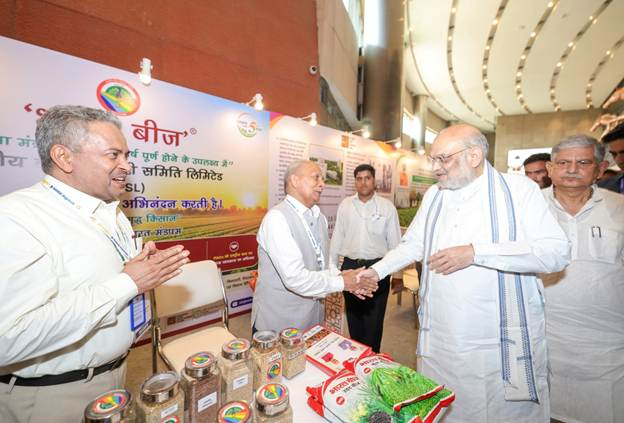
On this occasion, Union Home Minister and Minister of Cooperation Shri Amit Shah laid the foundation stone, dedicated to the nation and launched several important projects and initiatives. These included the transfer of 135 foodgrain storage godowns, dedication of 85 godowns and foundation stone laying of 47 godowns, bhoomi pujan of Sahakar Van by Amul and NCCF; bhoomi pujan of BBSSL tissue culture facilities at Barabanki in Uttar Pradesh and Jalgaon in Maharashtra, launch of NCD 3.0 and the geo-tag mobile application; launch of NDDB’s milk supply review dashboard portal, launch of initiatives related to the productivity of dairy animals under Cooperative Inputs and Services Delivery Multi-State Limited; inauguration of the Cooperative Milk Producers Organization Multi-State Limited, inauguration of Gomay Cooperative Society Multi-State Limited and unveiling of two major initiatives of NUCFDC — Sahakar CBS, a centralised core banking platform, and Sahakar Sahayogi, a conversational AI-powered platform for Urban Cooperative Banks. The programme also marked the milestone of transformation of 50,000 PACS into e-PACS, a significant step towards the digital empowerment of grassroots cooperative institutions. An MoU was also signed between BBSSL and ICAR to strengthen seed systems. On this occasion, Shri Amit Shah also released the model by-laws for dairy cooperative societies and a book based on the achievements of the Ministry of Cooperation over the last five years.
