Fireside Chat with Mr. Mukesh Ambani and Mr. Larry Fink in Mumba; Fundamental Opportunity Is Huge Intellectualism Of India, Transformed Technology Larry Fink: The need to rapidly expand AI opportunities is necessary. I would first and state that I don't believe there's an AI bubble. I believe the greatest risk we have is if we don't continue to invest, China will win.
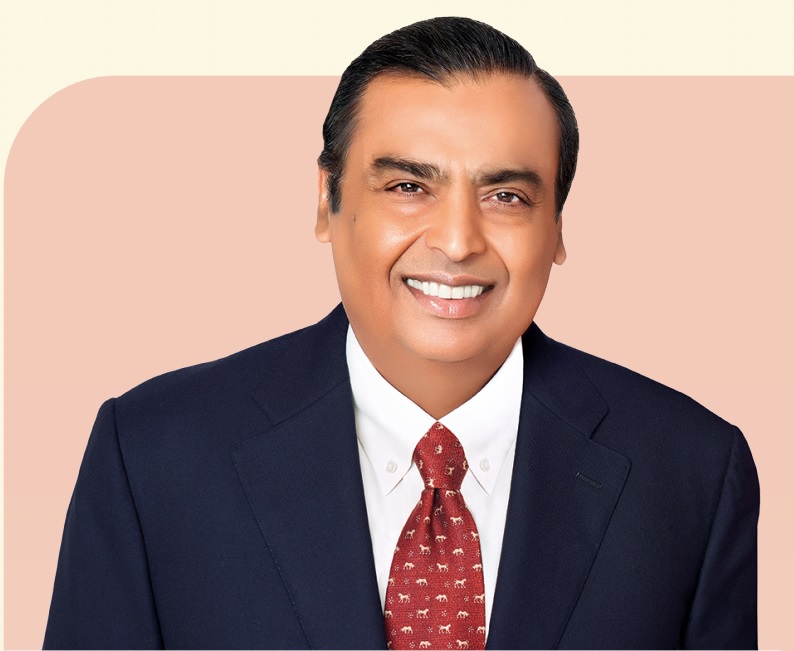
FinTech BizNews Service
Mumbai, 4 February 2026: The Fireside Chat with Mr. Mukesh D Ambani (CMD, Reliance Industries Limited) and Mr. Larry Fink (Chairman & CEO, BlackRock) was held today at JioBlackRock’s ‘Investing For A New Era’ event.
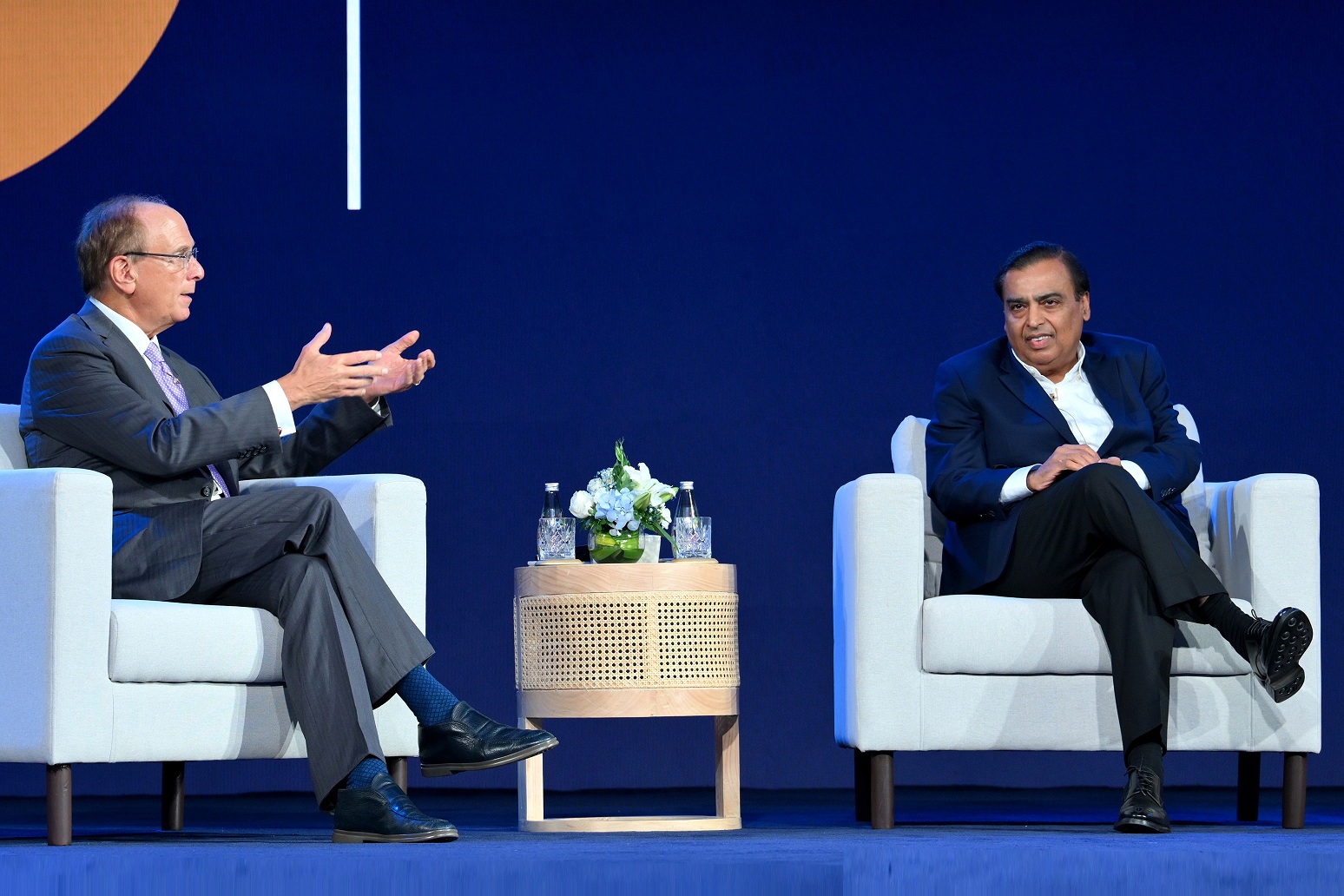
the Fireside Chat with Mr. Mukesh D Ambani (CMD, Reliance Industries Limited) and Mr. Larry Fink (Chairman & CEO, BlackRock) held on Wednesday at JioBlackRock’s ‘Investing For A New Era’ event.
Here is the complete transcript of this Fireside Chat:
Moderator:
Mr. Ambani, Larry Fink, thank you very much. And welcome to, a warm, sultry Mumbai from a very cold Davos, where Mr. Fink you were in the throes of conversation with world leaders about the world order or the world disorder. So, let's get started with that. We're talking about investing in a new era. What are the changes that you foresee that will shape the investment choices, the investment decisions of leaders like you as we look at this new era?
Larry Fink:
Well, first of all, it's great to be here in Mumbai. It's great to spend time with my partner Mukesh and the entire, Reliance and Jio teams. It's a real honour to be here. The weather here is nicer than it is in Davos and much nicer than New York, where I had our board meeting last week.
So, it's good to be here.
You know, we talk about a new era to give people a foundational understanding of where we are. But, as an investor, our job is to have people focus on the real opportunities to invest over a lifetime. There's so much information that confuses people. And the reality is, for most people, they need to be in a position to grow along with the growth of their country. So, when you think about the growth of India, it's not a quarter, or a day or a week, or a year. It's over a long horizon. And you could say maybe this is the era for India and will be so over the next 20-25 years.
But if you use the era of India as a foundational paradigm for a second, the key for us, at JioBlackRock is to compel more people to understand. What does that mean? The era of India and how do you participate in it?
What we've learned in the United States for that segment of the population that had invested with the growth of America is that they're far better off than those who just kept all their money in a bank account. And so, the key is, if you believe in the era of India, which I believe in, we need to get more people investing alongside the growth of a country. And that's the role of the capital markets. That's the role of what we can be doing together. The focus should be on how we live, how we grow, how we educate ourselves. Those are subsets of the era of India, and the opportunity to be an investor alongside the growth of India.
And to me, that's a compelling story. It's not about, you know, tariffs or President Trump or anything else. We need to be compelling people to think about the horizon of investing over a long period of time to grow with the great companies of India, to be a part of that story.
And I I'm absolutely convinced that in the era of India, we need to compel hundreds of millions of Indians to invest alongside the growth of India. That will actually transform India in so many ways, because as more and more families invest alongside the growth of India, India has less needs for the importation of capital.
I do believe in importation of capital from foreign investors who believe in the era of India, but more a fundamental foundation of any country is having the domestic economy being built on the back of retirement savings, which can be invested.
Moderator:
Well, thank you very much for those opening remarks. And, you know, the era of India, says Larry is certainly going to be one of the headlines that goes out this evening. But if I could ask you to explain to us what excites you the most about India, you referenced the tariffs and, you know, we've had a deal with the US overnight. President Trump and Prime Minister Modi have signed off on that reciprocal, tariff agreement. So, the overhang has lifted at least on one aspect of that relationship. How crucial a development is that and what excites you the most about India today?
Larry Fink:
Well, let's be clear. Over a 20-year period, this has no bearing. Maybe over the next six months or a year it may be a significant variant. But over time, the foundational issues of India, how it's able to leapfrog…watch what it has achieved over the last few years since the era of the smartphone. And I think that's a pivotal point, 2012 was… I mean…think about your life before the smartphone here in India, but the beginning of the smartphone, the rollout of 5G and how that transformed India in so many ways.
When you think about how the Modi administration digitized the rupee and how it transformed commerce in India across the board, I am very worried about other countries. Even the United States is falling behind. We need to be digitized. We need to be thinking about how this all plays out. I think this is part of the democratization of India.
And now India is a leader in this. And I can cite many things that give me optimism. But the fundamental opportunity is the huge intellectualism of India… transformed technology…whether the technology spread from the US or somewhere else in the world, the dispersion of that technology in India is really what is so inspiring, and the utilization of the new technology for more and more people and how that transforms commerce, consumption, information, education, all of that is ripe for real solid growth.
And I agree that India over the next ten plus years, is going to grow anywhere from, you know, 8 to 12%, probably hovering around 8 to 10. And that's a place where I want to personally invest in. And what we need to do is compel more Indians to invest alongside that growth.
Moderator:
Well, we certainly hope that more Indians are going to be investing in that story as well. And speaking of one such Indian… Mr. Ambani, now you've seen India over the last two decades transformed itself in many, many ways, especially as far as the digitization era is concerned. Specifically, what excites you? What is compelling about the India story today? How have you seen it being transformed?
Mukesh Ambani:
Well, before I answer that, let me warmly welcome, Larry. And I'm grateful to Larry for again coming back to India. It was a conversation that we had in 2023, and it just took him and me five minutes to say: “Larry, Blackrock should be back in India.” And he said yes. That's all it took…five minutes.
Larry Fink:
Right. We had to go to from point A to point B, and we accomplished it in a car ride.
Mukesh Ambani:
In terms of…you are here with your full team and we launched the business. So, thank you again for coming back to India. And India warmly welcomes you and your colleagues. And to all my colleagues from the industry and the financial community, a very warm welcome, and we look forward to working with, each and every one of you as, Shereen said.
I think that you know Larry, there is an old Indian saying that a tree only attracts attention if it bears fruit. And today, in this new era as you described it, India and the tree of the Indian economy is bearing fruit with great visibility, sustainability and abundance, as everybody said. Right.
We are confident…we are the fastest growing large economy in the world. Growing at around 8 to 10% is possible and doable. And I think that sustained double-digit growth is not ruled out.
So that is why, after a long time, we are attracting all this attention. And this has happened, primarily because I think that the last 10-15 years, we had two successive periods. where during ten years of Manmohan Singh, we focused on growth, and then we were very lucky to have now consistently 15 years of very stable leadership.
So stable economic leadership defines a country. And I think that we have to be thankful to Prime Minister Modi for giving us this stability. By 2029, it will be 15 years. I also think what is different about this is we've got a very clear goal, a goal in terms of saying we have to be developed, Viksit Bharat by 2047, which every Indian aspires to and believes in.
We've executed that skill, right. While as Indians we like to criticize ourselves and it is a good thing in a democratic mindset. But, if you see, we made more roads in the last 15 years…multiple times than any other country, including the United States at its peak.
We are now the leading renewable power producer in the world. In our own industry, we have built digital capacities, including 5G. That is better than most people in the world and cheaper than most people in the world in terms of pricing power. And now every Indian village has got 5G. So, I can go on like this… we built the same thing in terms of infrastructure, the roads that you see in Mumbai for a long time, we said that we will connect Mumbai to the mainland and now we have the bridge that is running.
So, we've executed. We've also had policy which is sustainable. I think this government was wise enough to say we've had continuity in policy at all times in terms of that. We've had stability. We've had predictability. We've also been conservative.
Just as successive Indian successive finance ministers have maintained…that relative to global debt, our debt is still just 50% of GDP. So we are not like the world, where the norm is now 100%. So, we've had… and I think that… in the private sector, what excites me the most is the startup industry. When I interact with startups and we see young 28–30-year-olds starting up companies, and I can clearly see, right, 100 new Reliances in terms of where they are going and the aspiration, the confidence that they have.
And finally, it is the confidence that you see, fortunately, we now operate across the length and breadth of India. So, it's not only the confidence in forums like this, but when you see the confidence in young people going to school and colleges wanting and in parents today believing that their tomorrow is better than today, right? And that is a big, big change in India that all of us…this is our baby boomer generation.
This is the Indian generation that believes that they will make a better tomorrow than today. And that's the confidence that we see as a result of all of this. And I also don't want to rule out that last 15-20 years we have had great law and order. And that is a prerequisite to continuous economic growth, social harmony, all of these things matter in terms of that.
And hopefully these are now setting the foundation for many, many decades. The world sees that. And that is why, you know, even like after the budget we had the European treaty, fortunately we had US deal…So the world is looking at us...We at Reliance get at least every month 3 or 4 global majors. We cannot see us to everybody for partnerships in terms of saying we want to come to India and can we work together. So, the world is taking notice of India. It's, tree laden with abundant fruit. And I have always believed that for profit and for prosperity, nobody needs an invitation. And that is why we are attracting all the people.
And I think this is very, very sustainable over decades to come.
Moderator:
Sustainable for the coming decades…And 100, more Reliance is, in your words, from the startup ecosystem, if that comes true and that bears fruit, it will be a very, very different economy, as you point out, Mr. Ambani. But, you know, I just want to understand from you, since we're talking about Jio Blackrock, we're talking about the opportunity for India's financial sector. A lot of people are asking is the ambition and aspiration is to disrupt this business, just as you did with telecom.
Mukesh Ambani:
Well, our ambition and aspiration starts with what I admire about Larry. Larry is not only like a result -oriented CEO of a top global multinational, but I think he has a very compassionate and passionate heart. When he told me that look, like at the end of the day, the purpose of BlackRock is not to just make short-term results or not even to make the returns right… for my investors and my shareholders, if I cannot put this money to work first for the betterment of society. Ans as a byproduct I give my investors and shareholders returns, then I would have done my job. And that is the Reliance philosophy for me. I've always believed that is where our minds match. And the purpose of JioBlackRock. Right.
And I think that the disruption is fashionable. But the opportunity that we see is that Indians have really been savers, right? Right. If you look at our history, we have saved consistently over the last five, six decades. What has happened is that some of this saving is not being productive. If you see just the last year, right, we as India imported $60 billion worth of gold and we imported $10-15 billion worth of silver and all of this not for industrial use, but really for domestic savings in terms of now, this is unproductive.
If we can actually convince the Indian saver that if one invests in the capital markets in a safe, transparent and consistent way, there are returns. And these returns…as we heard from all the panelists…compound. And for us at JioBlackRock, the opportunity is to encourage Indians to save. But to make sure that we give them the options to convert those savings into earnings, and hopefully compound their earnings so that they not only work for themselves, but they also work for the Indian economy.
And that propels the Indian economy to grow in terms of what we want to do. And then we all grow together. So yes, if you call that disruption, we will use technology distribution to achieve that for every Indian, for every Indian household, for every Indian small business and large businesses. That's our objective.
Larry Fink:
So, look for the foundation and the beginnings of Blackrock. We never focused on targets of growth ever. And yet our focus has been relentlessly on the client, whether it's a client who's awarding us ₹100 or a sovereign wealth fund, who is awarding us tens of billions of dollars. If you are working on behalf of each and every client, and you're serving that client over a long horizon with good advice, with, maybe, a degree of safety and importantly, just confidence building about the opportunities of compounding over a long period of time through the utilization of technology to intersect more often, more frequently, to have a deeper, broader relationship with your clients.
That's how disruption occurs. But disruption does not occur because you set a target. The target is making sure you're living with purpose every day, with each and every client. And if you can achieve that with consistency day after day, clients will reward you with more share of their wallet. And so, to me, it's just a process you have to earn every day, live every day. And if you do that properly and you are embedded in the culture of the firm, we can be disruptive. But you can't be otherwise.
Moderator:
Yes, we can't be otherwise. You need to have the alignment of values. And then of course, everything else builds on top of that. Mr. Ambani, let me come back to you on investing in India's growth opportunity and this new era that we're speaking about and the role of making strategic choices today, which will require patient capital.
And I want to understand from your perspective what it will take actually to build patiently with patient capital over the next two decades.
Mukesh Ambani:
Well, I think that the Indian opportunity, as we stand, we stand at about $4-4.5 trillion (Tn) of GDP in a $110 trillion world, right? I see us outgrowing the world and finding the right place. So, I am one of those believers who think that this $4-4.5 billion in a 20, 30-year period, right, will outgrow the rest of the world, and we will hit $25-$30 trillion. It's going to be 30 years from now. But as we do that, the India opportunity is, a 10-20-30 year opportunity. And when you think about solving India's energy problems, I am a believer that in the next decade, India will not import 80% of its energy. We have a path and God willing, like with technological breakthroughs, we will be reasonably self-sufficient in energy investments which make us self-sufficient. These are 20–30-year time horizons.
Investments in physical infrastructure that we still need...we need…like we have the opportunity to build with today's technology the physical infrastructure for 1.4 billion people. We've done a lot, but there is a lot more to do. These are also 20/30-year opportunities.
In terms of technology infrastructure, we are not going to be behind the world in terms of building country scale intelligence infrastructure, so that every village has intelligence available to them. And this also is a 20, 30-year opportunity.
Each one of this is hundreds of billions of dollars of investment. And within that, while the benefits are there, right, they're long term sustainable compoundable opportunities. And that requires sustainable capital, which comes both from within and outside. And to my mind…in our own experience in most of our industries is that it is not capital which is a problem. It is opportunities and execution. Right. And the ability to give an overall transparent framework to both the consumers and the investors, which is the opportunity. It's not going to be limited by patient capital. The world recognizes India, because the world also doesn't have many such scale opportunities where they can deploy on a few projects, hundreds of billions of dollars.
Moderator:
Absolutely. The market, of course, in India, presents a very compelling opportunity across different sectors you spoke of. But let me think. Let's talk about AI and the power, the potential of AI. And you're a big believer in the AI story, not just for BlackRock, but in general, you know, the stock market volatility notwithstanding the fact that we're spending hundreds of billions of dollars in this AI infrastructure buildout, and this is sort of front-loaded spending. And there's a question mark still on the revenues and the returns. How do you sum up what is happening in the world of AI today? What do you look for? What do you look at?
Larry Fink:
I would first and state that I don't believe there's an AI bubble. I believe the greatest risk we have is if we don't continue to invest, China will win.
And I believe the need to rapidly expand AI opportunities is necessary. That doesn't mean we're not going to have some bankruptcies, some failures. That's capitalism, yet have some big successes and big failures. But the opportunity that companies have in utilizing AI, is going to be present in everything we do. I mean, even yesterday you had anthropic and now it's a new model, which is going to be threatening for some businesses, but it's going to be an opportunity for other businesses.
You mentioned Davos and you mentioned the word cloud. There's no question AI is among the most topical conversations we're having now because it is disruptive. It's going to be disruptive for some industries. But it's going to also be very advancing. I mean, the future of AI in terms of drug discovery, in terms of humanity, is real.
The use of AI for the development of new sources of power or cheaper sources of power. What can that mean in the long run for the Global South? Could we have abundance in energy one day and how? Wow, that's still pretty far-fetched at this moment. But the opportunities for the acceleration of science are there. Rob Goldstein talked about, you know, having the ability to use AI to learn everything about one subject in minutes now.
And so, AI is going to allow more discovery, more opportunities. And with that technology, like so many other technologies, it's going to be disruptive for some businesses in some economies. And the key for AI to be really successful in every society, we need to make sure that AI broadens economic success, and it doesn't narrow economic success. We talked about that a lot in Davos the last two weeks, and that's going to be the real issue.
Can I be not only disruptive, but can it be expanding and broadening economic success throughout all economies. And that's going to be the big question about, you know, how do we play that out. In the early part of AI, you're going to see countries that are huge winners and some countries that are going to be left behind.
And so, you have all this cynicism around how AI is going to be playing out that is in the short. Over the long run, I think it's going to be more democratizing. But in the first few parts of AI, it's going to be more limiting. And so, we look at AI as a huge opportunity, for us in navigating out the $14 trillion that we manage on behalf of our clients, we have to use advanced technologies to process the business that we are already doing.
And the same thing for all the other major companies through AI, you have better understanding of your clients, better understanding of your inventory controls. You have so many advantages by the application of AI and technology. And that is, in the long run, to be very powerful.
In so many of the developed economies we have excessive deficits. It’s a conversation that was not talked about in Davos about the excessive deficits, which is a substantial problem for many of the developed economies, including the United States. Can I increase productivity and if so, can we increase GDP with a diminishing population? That's going to be the question that Korea is going to be asking, and Japan is going to be asking and Italy, can you have a growing economy?
Can you have a broadening of economic success with fewer people, with the utilization of AI and robotics? I believe the answer is going to be profoundly yes, but it also means countries that have very rapidly growing populations, it is going to be a bigger question for them. I think India is at the nexus of a large-base population, but the one thing that I've noticed is India is more accepting of technologies than many of the developed countries. India is more accepting about change than most developed economies. And so, because of the large-scale population AI is going to have, is going to create jobs and disrupt jobs. But for those economies that are willing to accept change and rapidly deploy that change in a positive way. And I think about India, the way it rapidly transformed its economy with the digitization of the rupee.
I mean, to me, that was a wonder to watch. And so, to me, AI is going to be a powerful growth engine in the world, but we need to make sure it's a growth engine for more.
Moderator:
Yeah. Absolutely. Right. And you know, to your point about India surprising on the digitization front, this was a surprising fact for me as well. The Binance CEO in Davos told me that India is the number one adopter of blockchain technology. And that's something that I was not aware of. But Mr. Ambani, since we're talking about AI and we're talking about technology to Larry, things point, how do we leverage all of this to create shared wealth creation?
Mukesh Ambani:
Well, I think that I'm a believer and have been a believer that we have to embrace technology. We cannot run away from it. From an India point of view, it is hugely advantageous. If we think about 200 million children in our schools and if we now think about connectivity to all our schools, and we give ourselves a goal that in one decade, right, with a fraction of the total GDP that others spend on education, we can deliver to each of these 200 million kids, including in the remotest village, quality education, I think without AI, this problem we could not have dreamt about solving it. And we are also participating in this opportunity. This is a solvable problem.
You take healthcare and say India is a large economy, 1.4 billion people, but without any social security, without any organized, health safety net. Right. As yet, relative to all the other countries, can we deliver everybody, like the large economies, spend 8-10-12% of their GDP on delivering health care to their citizens. Large amount of it is wasted. And everybody recognizes this. Can we in India take care of all our 1.4 billion people with a digital physical health system at a fraction of global costs? Answer: This cannot be done without AI
Security, right? Again, critical for our safety for all our 1.4 billion people if you use AI. And complemented with your law enforcement policies it is possible to do.
Simple taxation. We can now have the ability to have for each citizen, each company, transactional transparency. So, your tax becomes as simple as when you stay in a hotel and you have an electronic system, you can see all your transactions both ways, and there are no disputes.
And it becomes a much predictable, enforceable society. So that's AI and we shouldn't get scared of AI. It's exactly like when the industrial revolution came, okay, humanity moved forward. We moved, productivity moved forward. We moved from 0.3% growth for many, many decades or many centuries to 3% growth overnight. And at that time, if you go back 200 years and if you ask people where can people travel 2000km a day? They would have said, not possible today. But with flying, we can now travel 30,000km a day. And I think we are just at the beginning of that age. We must embrace it. India has the opportunity and what we see, as you said, is we see that young Indians as a common subset of old Indians. Right? India just adapts to technology faster than everybody.
We've seen it first hand over the last five years in terms of what we want, and we should use that to our competitive advantage. Embrace this, get the productivity advantage, get the earnings advantage, build a better society in terms of and use tomorrow's technology before anybody else so that we catch up from our $4,000 or a few thousand dollars per capita to double digit per capita, and then get to the US level, which is still at $40,000-$50,000 per capita.
So, we've got a long way to go. This is a part to catch up, and I think the world will allow us to catch up with them in the next two decades, and that is an opportunity.
Like from my point of view at Reliance, we're taking this opportunity with both hands. In terms of that, it's, once in, tens of centuries of opportunity. And, we can like, if we embrace technology, if we allow you to embrace that right then in the next 20-30 years, we can redefine India and find our true position in the world.
Moderator:
A multi-generational opportunity, as you put it, Mr. Ambani. But, Mr. Fink, you know, let me address the issue that you brought up and said it didn't get enough attention in Davos and that was deficit. But what did get a lot of attention in Davos was, of course, the interest rate trajectory that the world is going to be faced with. And as you know, how you see some of these factors impacting markets globally, the investment sentiment globally as well. Where do you see interest rates headed? Do you believe that we're likely to see more cuts coming in? And what will be some of the other crucial risks that investors need to watch for?
Larry Fink:
Well, all those questions are for the short term. So let me answer just some short-term questions. Look at the markets. The markets are honest. I mean, on any single day the markets may miscalculate something. But over time markets are a great mirror of what's really going on. So, whether there's political pressure one way or the other, sure.
That could shape a market over any one day or week, but the markets actually are bigger than any individual or any economy. And so, if, if the Federal Reserve eases too early and we see inflation, we see measures that prove it wrong, you're going to have a steepening of the yield curve. So, all those issues to me are not that important to be honest. I know they're important for day traders.
They're important for the media because we could talk about all the churn and all that. But it really doesn't matter that much. And I don't really spend that much time focusing on those types of issues. Any over of course, of any one quarter, any one year. Yeah, sure they matter. But over time the markets correct itself and rebalances itself.
And that's pretty much the message that we have to constantly talk about, because the message is not about the moment. And everybody gets so confused about politics, the polarization of opinions, you know, the politicization of everything. And yet over time, that's the beauty of markets. The markets are an honest reflection of global economies over the long run.
And that's… and if you believe in humanity, if you believe that we correct our problems over time, I actually believe the things you read in the newspaper, all of the stuff we read, that's frightening. but I get actually excited because we're talking about those issues, and generally we mitigate most of the things that are on the front pages.
So, I actually…when I see all these terrible things, I try to assess each. And one of those things may be really terrible, but the fact that we're talking about it and mitigates…we self-correct are the things that you don't read in the newspaper that you think are a problem. Those are the things that bother me, like the long-term issues of deficits, that we don't spend enough time talking about.
How do we mitigate it? The best way we mitigate it is through growth. And that's what I try to tell every political leader. How do you grow your economy? Because you grow your economy. The deficits will be smaller as a percent of GDP. But and so I, you know, I don't get bothered by most of the stuff I read because it's a good thing.
That's the power of the press to identify all the issues. But through that identification of the issues, we mitigate those issues. You know, you think about all the problems you read and all the wars and all the skirmishes. But in most cases, over time they resolve themselves. You think about how problematic everything is when we entered this year?
And yet over. You know, when you think about the beginning of 2025, everybody was so nervous about everything. Yet markets did great over 2025. We have some form of resolution in Gaza. In Israel, there are so many other areas in the world where we actually have diminished risks now. But if you ask the average person who reads a paper, they would think things are actually worse than they are.
And to me, obviously negative news sells far better than positive stories. And so, what I'm trying to say and my message to everybody is, yes, please be a global reader of what's going on, but don't get so alarmed by it, because we're going to mitigate most of those problems, because that's what we do as human beings. And that is the whole message about long term optimism.
You know, long term optimists generally win. I think, you know Elon Musk said in Davos, it's better to be an optimist who’s wrong than being a pessimist who's right. And I think about just Elon himself for a second. I've never met a person who is as smart as he is, but with the imagination that he has and the guts to do what he has done. And I think in building that out, and I would just like look at you (Mukesh Ambani)... the ambition, the imagination, and those are the key things in growth and opportunity. And to me, this is what we all want to be a part of. We want to invest with the people who have ambition, who have the guts to do things that break the mold, and changes society.
But they change society because of imagination and guts. And to me, that's the beauty of being a long-term investor.
Moderator:
Absolutely. So, being an optimist and getting it wrong versus a pessimist and getting it right, in Elon Musk's words, is more important. And you agree with him. But Mr. Ambani, you know, you were talking about the startup ecosystem. And I want to understand from you, you know, both of you spoke about changing the mindset from savings to investing. And both of you are focused on generating growth. What is the message to the young Indian saver today? What would both of you tell the Young Indian saver? And let me start by asking you, Mr. Ambani.
Mukesh Ambani:
Well, I think that to my mind, the India opportunity is genuinely a new era. It's now we can see visibly over the next 2 or 3 decades in terms of…all of us agree that growth… and we take growth for granted. But let me tell you, all over the world, people would die for 10% year on year growth. And we are growing on a large base and we will sustain that. So, for any young Indian, right, this growth is going to be converted to growth into his or her income. Right. And so, you would have income growth. We've got to continue our savings mindset. We still want to be conservative. We don't want to inherit too many deficit problems.
We are still okay. So as long as we save and if we make that mental mindset in terms of saying we will go and invest our savings to productive uses to grow with India.
Right. Access to investments and productive compoundable investments is complex. It's not affordable and it's not available to all. And that is what every young Indian should demand for. And it's our job in industry to do exactly what we did with Jio, that it should be available to all, and then people will benefit from the power of compounding.
I think that we talked about compounding, but money in a bank account lying in a simple interest is not compounding, right? Money and the stock market are compounding. And India has an efficient market. We have now regulated well. And if we can generalize this money to grow for every Indian along with them. Right. That is the opportunity that we have where hundreds of millions of Indians, right, become owners of wealth and don't only observe wealth creation.
And I think that India is well equipped. We have the institutional mechanism as well as the corporate mechanism is aligned with that very fact that we are here utilizing all the technologies to enable this for Indians. And within this framework, right, there are still many, many unsolved problems. And even after three decades, there will be many unsolved problems.
So, the opportunity for startups, I think in a big macro piece. Right. It's $110 trillion world, 4.5 trillion India. Right. And the $110 trillion world with AI productivity will go up to a $300 trillion world in three decades. Right? India has the opportunity to take its share…. So that is like $35 trillion. So, we have $30 trillion of new value, right?
That has to be created. And that means there is $30 trillion of new market value. And that is what people will participate in in the next three decades. And that's why even 100 Reliances may not be enough. But that's the opportunity for a young Indian starting today.
Moderator:
Now, I think, Larry, your message to young Indians in the context of what you've seen happen in the other countries that you operate in.
Larry Fink:
Mostly believe in your own country, believe in the opportunity to grow. I mean, think about it. If India can grow 10% a year, then let's assume that the stock market only grows at 10% a year, and generally it grows at a multiple of the growth of the GDP. But let's assume it, you know, that means you're doubling your pool of money every six and a half years.
Okay. That's a pretty good outcome. That's much better than keeping your money in a bank account. And, and to me, that's the foundational issue. Grow with your country. And if you believe that there's leverage in the system, which there is, you're going to if the economy grows at 10%, the equity markets, you know grow five, six points above that, over time.
And so, to me, that is foundational to build financial security dignity when you're in retirement. And to me, that is a whole foundational issue for a successful economy.
Moderator:
You know, you spend a lot of your time fishing, Larry, I believe, and, you know, I believe this deal got done in a car. But what was the bait?
Larry Fink:
A friendship.
Moderator:
A friendship. That is the perfect note to end this conversation. Larry Fink, Mukesh Ambani, thank you so very much for joining us. And giving us a long-term perspective of the strength of the industry and the strength of this partnership. Appreciate your time.
