Bilateral trade volume reached approximately $136 billion in 2024-25, making the EU India's largest goods trading partner. The ongoing engagement underscores a mutual commitment across trade, investment, clean and green energy, science and technology, security and defence, digital initiatives, connectivity, space, and agriculture.

FinTech BizNews Service
Mumbai, 24 January 2026: India’s engagement with the EU highlights its strategic focus on Europe, aligned with the upcoming India-EU Summit and the ongoing Free Trade Agreement.
Phase of renewed strategic momentum
India–EU relations have entered a phase of renewed strategic momentum, with both sides intensifying engagement ahead of the forthcoming India–EU Summit in New Delhi. India and the European Union are seeking to advance long-pending Free Trade Agreement (FTA) negotiations and adopt a new Joint Strategic Agenda to steer the partnership beyond the existing roadmap. This ongoing engagement underscores a mutual commitment across trade, investment, clean and green energy, science and technology, security and defence, digital initiatives, connectivity, space, and agriculture.
High-level India–EU engagements have strengthened in recent years, with the EU College of Commissioners, led by President Ursula von der Leyen, visiting New Delhi in February 2025 - the first-ever such visit to a bilateral partner outside Europe. Leaders also met on the sidelines of multilateral forums like the G7 and G20, most recently in June 2025 in Canada, and maintained regular contact through telephonic discussions, including calls between the Prime Minister, President von der Leyen, and President Antonio Costa in September 2025.
Overview of India-EU Relations
The relationship between India and the European Union rests on shared values and principles, including democracy, rule of law, a rules-based international order, and commitment to effective multilateralism. Ties encompass a broad spectrum, including trade and investment, security and defence, climate action and clean energy, digital transition, connectivity, science and technology, and people-to-people exchanges. The EU remains India's largest trading partner for goods, with bilateral trade reaching approximately $136 billion in 2024-25. EU is also among India’s top overall trading partners in both goods and services.
The multifaceted partnership, guided by the 'India-EU Strategic Partnership: A Roadmap to 2025' (adopted in 2020), continues to evolve towards greater mutual prosperity and global stability in the followingaspects:
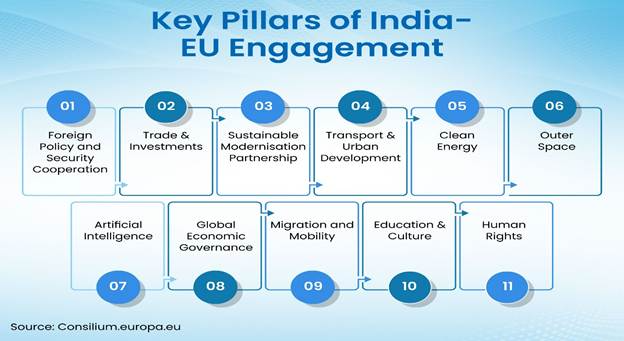
Past Engagement of India and EU
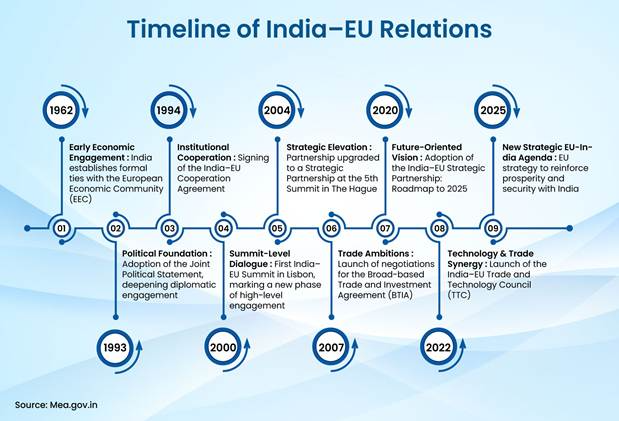
India-EU partnership has developed over decades, beginning with basic diplomatic engagements and expanding into a multifaceted strategic alliance that encompasses political dialogue, economic cooperation, security, and global challenges like climate change and technology. From initial recognition in the 1960s to the establishment of annual summits and joint initiatives in the 21st century, the ties have progressed significantly, reflecting mutual interests in trade, investment, and sustainable development.
Early Foundations
Diplomatic relations between India and the EU trace back to the early 1960s, with India being among the first countries to establish ties with the European Economic Community (EEC) in 1962. This laid the groundwork for formal cooperation, culminating in the 1993 Joint Political Statement and the 1994 Cooperation Agreement, which aimed to strengthen bilateral political and economic links.
Key Milestones Achieved in Early 2000s
In eary 2000s, several pivotal events shaped the partnership. The first India-EU Summit occurred in June 2000 in Lisbon, initiating annual high-level dialogues on political and economic matters. This was followed by the upgrade to a Strategic Partnership in 2004 at the 5th Summit in The Hague, expanding the scope beyond trade to include security and cultural exchanges.
Recent Breakthrough in India–EU Relations
In contrast to early 2000s milestones, which established the framework, developments have accelerated, with the adoption of the ‘India – EU Strategic Partnership: A Roadmap to 2025’ in July 2020, resumption of free trade and investment negotiations in May 2021, and the launch of the India-EU Trade and Technology Council (TTC) in April 2022. The TTC's second ministerial meeting in February 2025 in New Delhi further built on this, fosters cooperation in digital and green technologies, marking a shift from foundational dialogues to actionable, technology-driven partnerships.
India-EU Dialogue - Strategic Partnership Architecture
India-EU relations have significantly deepened in last decade, transitioning from primarily dialogue-based interactions to actionable, strategic collaborations across defense, infrastructure, investments, labor mobility, and emerging global priorities.
The 'India – EU Strategic Partnership: A Roadmap to 2025' has been instrumental in guiding this evolution, culminating in high-level commitments like the proposed Security and Defence Partnership and the Trade and Technology Council (TTC), positioning India as a pivotal partner in addressing shared challenges such as climate change, supply chain security, and regional peace.
Trade and Economic Focus
Trade has been a cornerstone, with the EU emerging as a significant partner. The bilateral merchandise trade between India and EU has grown substantially, reaching $136 billion in 2024-25, with EU exports to India including machinery, transport equipment, and chemicals, and imports from India featuring machinery, chemicals, base metals, mineral products, and textiles.
Moreover, from 2019 to 2024, India-EU bilateral trade in services exhibited steady growth, with Indian exports increasing from EUR 19 billion in 2019 to EUR 37 billion in 2024. Further, imports from the EU also saw an increase, reaching EUR 29 billion in 2024
Defense and Security
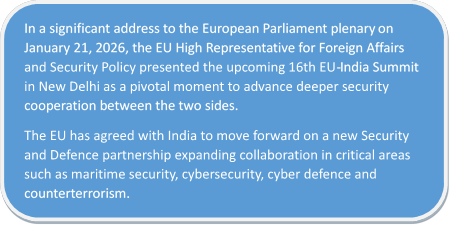
India-EU security and defence ties have deepened significantly in 2025, marked by the Leaders’ Statement from the February College of Commissioners’ visit to India[1], which agreed to explore a Security and Defence Partnership and included discussions between the EU Commissioner for Defence and Space and India’s Minister of State for Defence.
This momentum continued with a December 2025 delegation from the Society of Indian Defence Manufacturers visiting Brussels to engage with the EU Commissioner, fostering industrial cooperation. In September 2025, the EU Political and Security Committee - representing all 27 member states - made its first-ever visit to Asia, holding high-level meetings in India with the Foreign Secretary, Deputy NSA, and Secretary (West) to advance strategic dialogue.
Complementing these efforts, joint naval exercises have strengthened maritime security cooperation, including in the Indian Ocean in June 2025, the Gulf of Guinea in October 2023, and the Gulf of Aden in June 2021, alongside collaborative escort operations for humanitarian assistance near Somalia in 2018 and 2019.
Clean Energy and Climate
Energy and climate cooperation forms a central pillar of the India–EU partnership, reflecting shared commitments to sustainable development, climate action, and clean energy transition.
At the centre of India–EU energy and climate engagement is the Clean Energy and Climate Partnership (CECP), established in 2016, with Phase III adopted in November 2024, reflecting the growing scope of bilateral cooperation. The EU has been a partner of the International Solar Alliance since 2018, supporting solar energy deployment, while the European Investment Bank finances sustainable transport and urban mobility projects, including urban rail and metro systems in select Indian cities.
India-EU Cooperation also covers offshore wind energy, gas infrastructure development, methane emissions reduction, investments, and technology transfer, and the EU’s joining of the Coalition for Disaster Resilient Infrastructure (CDRI) in March 2021 underscores shared priorities on climate-resilient infrastructure. In advanced scientific domains, India and the EU signed an R&D agreement on peaceful uses of nuclear energy with EURATOM in July 2020, and India has been an associate member of CERN since 2017.
Connectivity
India and the European Union have steadily expanded their cooperation on connectivity as a strategic pillar of their partnership, aimed at promoting sustainable, inclusive, and resilient linkages across regions. India–EU connectivity initiatives seek to enhance economic integration and support balanced development beyond bilateral engagement.
India–EU Connectivity Partnership (2021) - Launched in 2021, the India–EU Connectivity Partnership seeks to strengthen cooperation across transport, digital infrastructure, and energy networks, while facilitating the seamless movement of people, goods, services, data, and capital.
Trilateral Development Cooperation (June 2025) - In June 2025, India and the European Union agreed on an administrative arrangement to advance trilateral development cooperation, enabling joint implementation of development projects in third countries.
India–Middle East–Europe Economic Corridor (IMEC) (September 2023) - On the margins of the G20 Leaders’ Summit held in New Delhi in September 2023, leaders from India, the European Union, France, Germany, Italy, Saudi Arabia, the UAE, and the United States announced a Memorandum of Understanding to collaborate on the development of the India–Middle East–Europe Economic Corridor (IMEC).
Science & Technology
Science and technology cooperation is a key pillar of the India–EU partnership, supported by institutional frameworks that promote collaborative research and innovation.
Bilateral engagement is anchored in the Science and Technology Cooperation Agreement signed in 2007, with a Joint Steering Committee guiding cooperation in areas such as smart grids, water, vaccines, ICT, polar science, and the mobility of young scientists working with the European Research Council.
In addition, the Ministry of Earth Sciences and the European Commission have established a co-funding mechanism to support Indian participation in selected projects under the European Research and Innovation Framework Programme “Horizon 2020”, particularly in climate change and polar research
India-EU Space Cooperation
Space cooperation represents an important dimension of the India–EU strategic partnership, built on decades of technical collaboration and growing institutional engagement.
India–EU engagement in space dates back to the 1980s, when Indian satellites were launched using Europe’s Ariane launchers. Subsequently, the Cooperation Agreement between the European Commission and the Department of Space strengthened collaboration in Earth observation, including mutual access to data from Earth observation satellites. In parallel, ISRO and the European Space Agency (ESA) have signed cross-support arrangements, enabling exchanges in navigation, operations, and data handling, including during key missions such as Chandrayaan-3 and Aditya-L1. Further reflecting operational cooperation, ESA’s Proba-3 mission was successfully launched by ISRO’s PSLV-XL in December 2024.
High-level institutional engagement has accompanied these operational linkages. In February 2025, the EU Commissioner for Defence and Space met the Minister of State for Science and Technology in New Delhi to discuss avenues for enhanced cooperation. This was followed by the inaugural India–EU Space Dialogue, held in Brussels in November 2025, providing a dedicated platform for structured engagement. Additionally, in May 2025, ISRO and ESA signed a Joint Statement of Intent on Cooperation for human space exploration, marking an expansion of collaboration into future-oriented space domains.
Migration and Mobility
Early migration dialogues have progressed into structured frameworks like the 2016 Common Agenda on Migration and Mobility (CAMM), emphasizing skilled worker flows, social security, and orderly migration to meet EU demographic needs and India's workforce surplus.
The 9th High-Level Dialogue on Migration and Mobility (November 2025) advanced implementation, proposing a pilot European Legal Gateway Office in India for ICT professionals and exploring comprehensive mobility frameworks for young professionals. At the end of 2024, a total of 931,607 Indian citizens resided in the EU, the largest group (20.8%) for Blue Cards holders, (16,268 in 2024).
Indian students have been among the top recipients of the Erasmus Mundus scholarships. In the last 20 years, over 6,000 scholarships have been awarded to Indian students for studying and working at leading institutions across Europe.
Strategically, this supports India's diplomatic outreachthrough migration partnerships enhancing human-centric ties and global talent flows amid expansions like new European missions. India's advancements are evident in streamlined legal pathways and qualification recognition, positioning it as a key talent source for both India and EU nations.
Conclusion
India–EU relations have evolved into a strong and forward-looking partnership based on shared values, growing economic ties, and common strategic interests. Rising trade, steady EU investments, and cooperation in areas such as connectivity, clean energy, digital technologies, security, and labour mobility reflect a partnership that is producing clear and practical outcomes.
Initiatives such as the Trade and Technology Council, the Global Gateway, IMEC, and progress in FTA negotiations reflect deepening institutional alignment between India and the EU. Building on this momentum, India’s invitation to the President of the European Council, H.E. Mr. António Luís Santos da Costa, and the President of the European Commission, H.E. Ms. Ursula von der Leyen, for a State Visit from 25–27 January 2026 underscores government intent to elevate India-EU relations as a core pillar of its global and European strategy.
