India’s Growth Fundamentals Remain Strong Amid Global Volatility: Government of India
FinTech BizNews Service
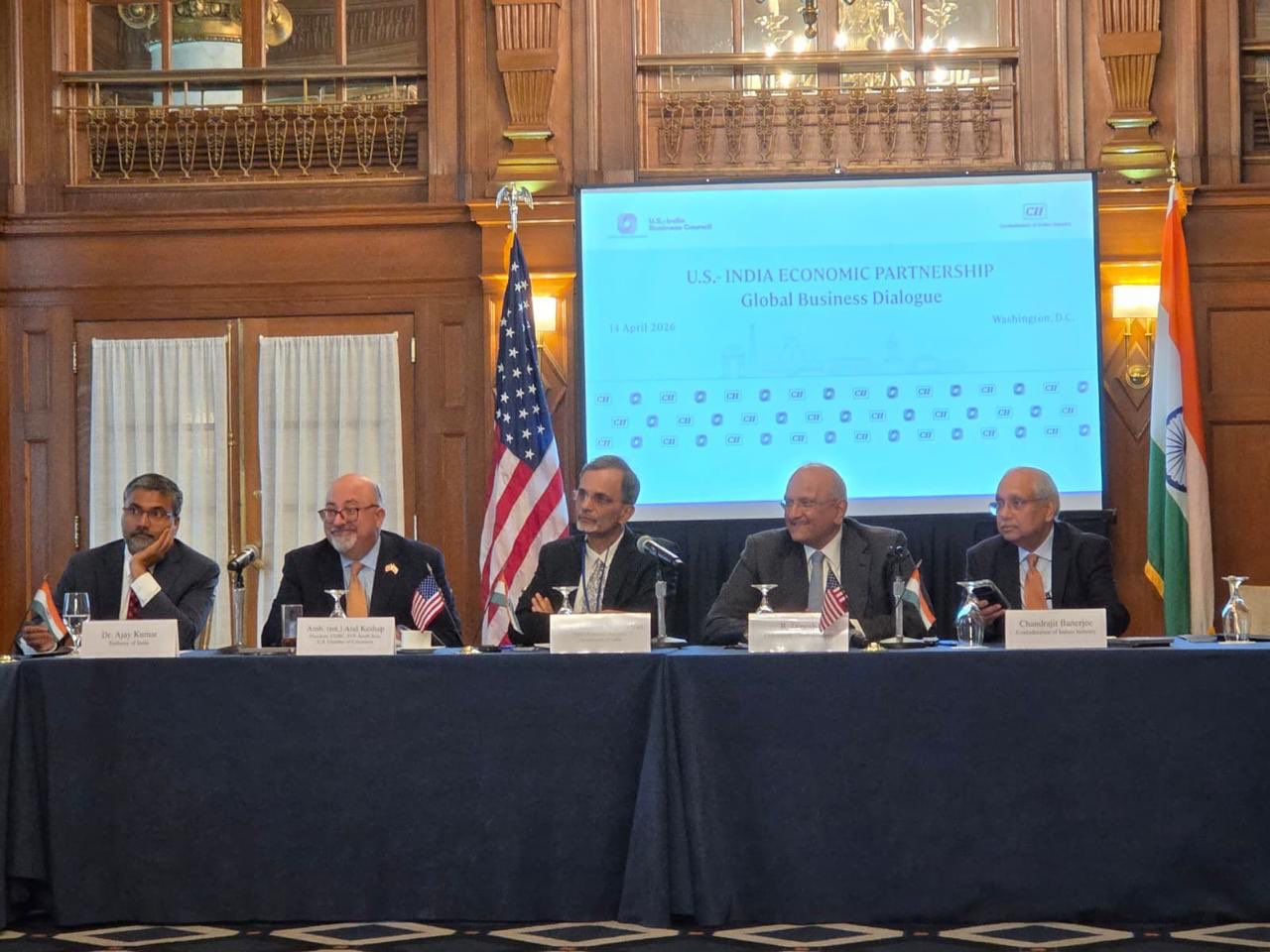
Mumbai, April 16, 2026: India’s long-term economic outlook continues to be anchored in strong macroeconomic fundamentals, sustained reforms, and a forward-looking innovation agenda, senior policymakers from the Government of India highlighted at a high-level roundtable convened by the CII (Confederation of Indian Industry) in partnership with the U.S.-India Business Council on the sidelines of the IMF-World Bank Spring Meetings at Washington, D.C.
The session brought together Ms Anuradha Thakur, Secretary, Department of Economic Affairs; Dr V Anantha Nageswaran, Chief Economic Advisor to the Government of India and senior leaders from global corporations, financial institutions, technology firms, and multilateral organisations to deliberate on India’s economic trajectory, reform priorities, and emerging investment opportunities.
Ms. Anuradha Thakur underscored that India continues to be a stable, trusted, and fast-growing economic partner, supported by policy continuity, institutional credibility, and a consultative approach to governance. She emphasized that India’s economic strategy is focused on enabling sustainable and inclusive growth, while maintaining a predictable and transparent policy environment for investors.
“India has emerged as a stable, trusted, and fast-growing economic partner, supported by strong macroeconomic fundamentals, policy continuity, and institutional credibility,” she stated.
Highlighting the importance of financial deepening, she pointed to the significant opportunities within India’s insurance sector, particularly in expanding coverage across underserved segments such as MSMEs, agriculture, and services. She noted that increasing insurance penetration remains a critical priority, both from a social protection perspective and as a driver of financial sector development.
“India’s insurance sector presents a significant opportunity not only in expanding coverage across underserved segments such as MSMEs, agriculture, and services, but also in mobilising long-term, patient capital. We are actively working to enable insurance and pension funds to play a larger role in financing infrastructure and supporting India’s growth journey,” she noted.
Ms. Thakur further highlighted that the government is taking concrete steps to enable long-term domestic capital to participate more actively in infrastructure financing. A dedicated committee has been constituted to examine the optimal deployment of insurance and pension funds, with a view to strengthening the availability of patient capital for large-scale projects.
She also emphasized the government’s continued focus on enhancing investor confidence through transparency and visibility of opportunities. Structured frameworks such as the National Monetisation Pipeline and the pipeline of public-private partnership (PPP) projects are providing a clear roadmap for private sector participation across infrastructure and allied sectors.
“Even as we advance reforms across sectors, our focus on the medium- and long-term vision of a developed India by 2047 remains unwavering,” she added.
Dr. V. Anantha Nageswaran highlighted India’s strong growth momentum, supported by rising domestic demand, infrastructure expansion, and ongoing integration with global markets. He emphasized that India’s approach to economic development is increasingly driven by competitiveness, productivity enhancement, and innovation.
He underscored India’s renewed push towards trade openness and deeper engagement with global partners, including the United Kingdom, European Union, and the United States.
“India is actively exposing its firms to global competition. That exposure is critical to driving productivity, research, innovation, and global benchmarking,” he noted.
Infrastructure development, he emphasized, remains central to enhancing productivity and enabling long-term growth. India’s investments across highways, railways, ports, airports, and logistics networks are significantly improving efficiency and reducing transaction costs across the economy.
“This is not just about headline numbers. It is visible on the ground—better highways, modern airports, expanded railway networks, improved ports and inland waterways, and enhanced power infrastructure,” he said.
Dr. Nageswaran also highlighted India’s evolving role in the global technology ecosystem, noting a clear shift from a services-oriented model to an innovation-driven growth paradigm. India is increasingly positioning itself as a hub for advanced research, design, and engineering, supported by a rapidly expanding network of Global Capability Centres.
“India today is no longer the back office of the world; it is increasingly becoming the global laboratory of the world,” he remarked.
He noted that this transformation is being driven by a combination of skilled talent, cost competitiveness, and a growing emphasis on innovation-led growth across sectors.
Concluding his remarks, Dr. Nageswaran emphasized the importance of sustained reforms and a forward-looking policy framework in shaping India’s long-term trajectory.
“India’s response must be resilience, diversification, and sustained reform,” he stated.
Representing the U.S.-India Business Council, Atul Keshap highlighted the deepening economic partnership between India and the United States and the growing role of private enterprise in strengthening bilateral ties.
“It is part of the genius of both America and India that our free peoples collaborate through the power of business and innovation. India today offers stability and opportunity at a time of global transformation,” he said.
Participants expressed strong interest in opportunities across infrastructure, manufacturing, technology, energy, financial services, and healthcare, reflecting the breadth of India’s growth story and its increasing attractiveness as an investment destination.
The roundtable reinforced the shared view that India’s combination of macroeconomic stability, reform momentum, and a forward-looking innovation agenda positions it as a leading destination for global capital and a key driver of future global growth.
