Development By Efficient ‘Last-Mile Delivery’: FM

FinTech BizNews Service
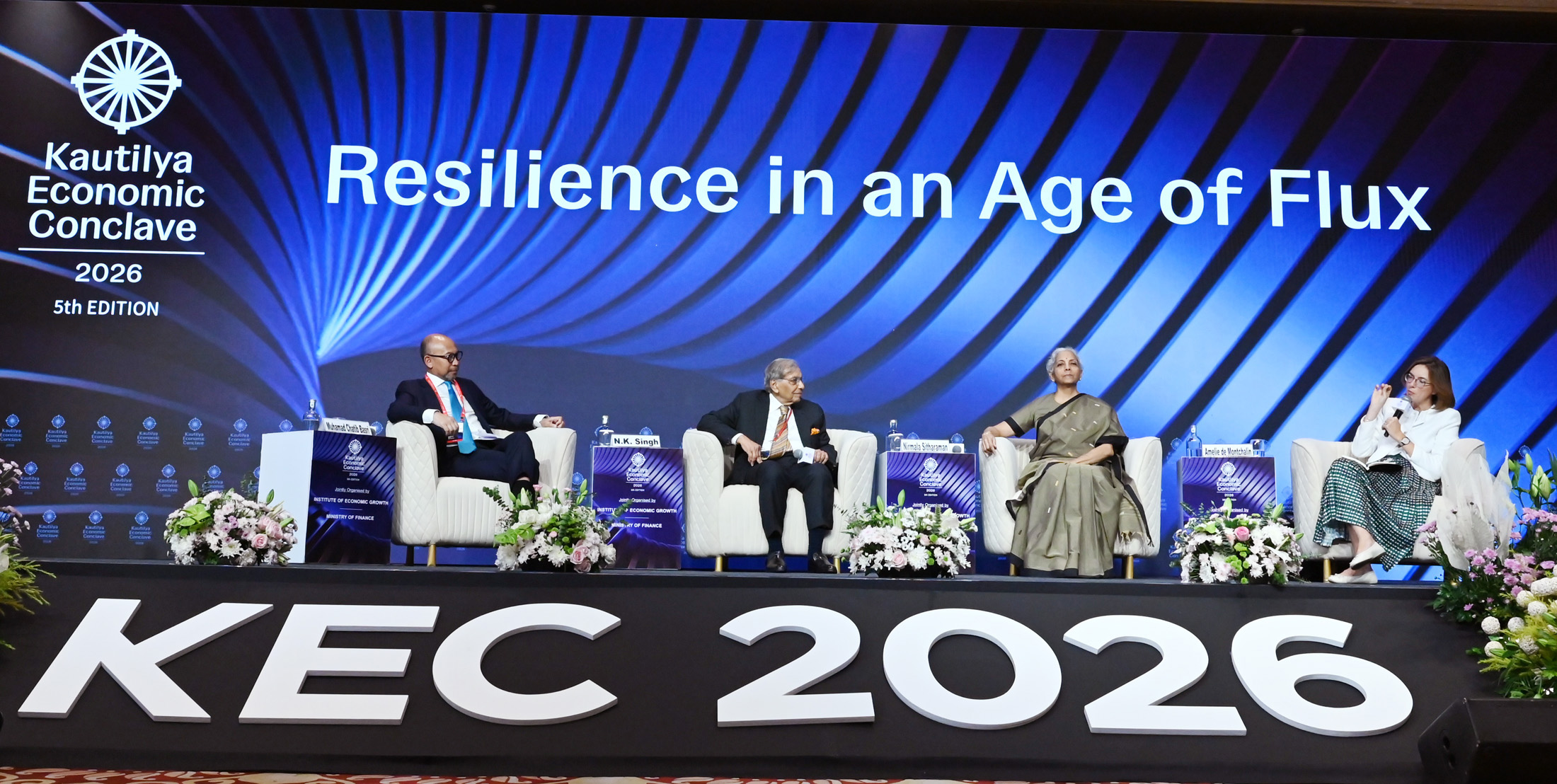
Mumbai, 03 October, 2026: Union Minister of Finance and Corporate Affairs Smt Nirmala Sitharaman addressed the gathering at the Kautilya Economic Conclave 2026 in New Delhi. The theme of the address was “Resilience in an Age of Flux”.
The gist of the FM Sitharaman’s speech is as follows:
“India has a leadership with a strong 'Reform Mindset'. Hon'ble PM Shri Narendra Modi approaches Reform as a matter of conviction, not compulsion. The Union Government has advanced national frameworks through GST, the Insolvency and Bankruptcy Code, the four Labour Codes and the Jan Vishwas Acts.

The task has been to make economic activity simpler, more predictable and more productive across the country.
The theme is “Resilience in an Age of Flux” and here's what we exactly mean by resilience? Resilience is the capacity to absorb a shock without losing the growth path and to retain the policy space to meet the next shock when it arrives. - The evidence of resilience lies largely in the counterfactual, in the outcomes that did not materialise: an inflation spiral that did not take hold, queues that did not form at fuel outlets, banking stress that did not surface and a fiscal correction that was never forced. These counterfactuals deserve as much attention from economists as the headline growth rate.
The shocks of the last 4 years have been primarily of 2 kinds. Older vulnerabilities returned in sharper form: crude price spikes amid recurring instability in West Asia and tighter US monetary conditions with their pull on global capital flows, while global trade barriers are also going up. The conflicts involving Russia-Ukraine, Iran and the disruption around the Strait of Hormuz, added a new kind of shock, one that threatened the physical movement of oil and gas as well as their prices. A price shock can be cushioned with monetary and fiscal tools. But a quantity shock tests buffer stocks and the reach of delivery systems and therefore the capacity of the state itself.
And these shocks have arrived in a world with even thinner buffers. Global public debt rose to nearly 94% of GDP in 2025 and is projected to reach 100% by 2029, a level previously seen only after the Second World War (as per the IMF Fiscal Monitor, April 2026). India has come through this period remarkably well with its fundamentals intact and strengthening. Real GDP grew 7.8% in Q1 FY27, CPI inflation was 4.82% in August 2026, the current account deficit was 0.5% of GDP in Q1, gross NPAs of banks are at multi-decadal lows and foreign exchange reserves stand at about $766 billion.
Since 2014, we have worked to strengthen the capacities on which sustained development depends: the State’s capacity to respond, the economy’s capacity to produce, and the ability of citizens and enterprises to participate in growth. The focus has been on efficient ‘Last-Mile Delivery’. The first foundation is strengthening resilience at the household level. This has been done by translating public expenditure and government initiatives into tangible improvements in people’s lives. The use of transparent mechanisms, strict monitoring and a zeal to deliver ensured that government schemes get delivered on the ground.
Non-food credit grew 18.8% in the year to August 2026, sustaining the flow of finance to economic activity. A strong banking sector is also helping enterprises facing external uncertainty; working capital and access to markets remain critical. The Emergency Credit Line Guarantee Scheme (ECLGS) helped meet working-capital needs, preserve operations and employment and withstand liquidity pressures during periods of disruption.
Fueling entrepreneurial spirit is an important step consciously taken after 2014. Access to finance has been central to this effort. PM MUDRA Yojana has sanctioned over 52 crore collateral-free loans, supporting self-employment and small enterprises. PM SVANidhi is aiding many street vendors. Formalisation of the economy is also helping in credit offtake at the non-corporate level. The government undertook a series of tough banking-sector reforms to strengthen the financial system - including recapitalisation and resolution of stressed assets, and stronger governance and risk-management frameworks. This has built resilience and is supporting us in the age of flux.
The cumulative results of sustained investment since 2014 are visible: - National highways have expanded by about 61%. - Operational airports have more than doubled. - Cargo-handling capacity at major ports has increased nearly 60%. - Indian Railways commissioned 36,429 km of new tracks during 2014–26. Through PM GatiShakti, coordinated planning has helped connect individual projects with wider transport networks, utilities and economic zones. Through SASCI, 50-year interest-free loans for capital investment have also supported and incentivised reforms by States. These investments have strengthened market access and expanded the physical capacity on which economic activity depends.
Another foundation that we have built since 2014 is the infrastructure that connects people, factories and markets. Its scale determines how efficiently goods move, how widely businesses can operate and how fully different regions can participate in the economy. In FY27 alone, we have budgeted Rs12.22 lakh crore in capital expenditure, including grants for the creation of capital assets, effective capital expenditure stands at Rs17.15 lakh crore, or 4.4% of GDP.”
