The Stepping Stone Towards Responsible & Agile Gram Swaraj With A Jan Bhagidari Led Momentum

FinTech BizNews Service
Mumbai, 4 January 2026: The State Bank of India’s Economic Research Department has cpme out with a the Research Report on the 'VB-G RAM G'. The report has been authored by Dr. Soumya Kanti Ghosh, Group Chief Economic Adviser, State Bank of India.
The overhaul of the erstwhile MGNREGA through the VB-G RAM G ( Viksit Bharat- Guarantee for Rozgar and Ajeevika Mission Gramin) aims to weave transformative practices and strategies factoring challenges of competitive project identification, productive asset creation, superior income generation and efficient monitoring mechanism...fixing structural weaknesses while enhancing employment, transparency, planning and accountability at all levels.
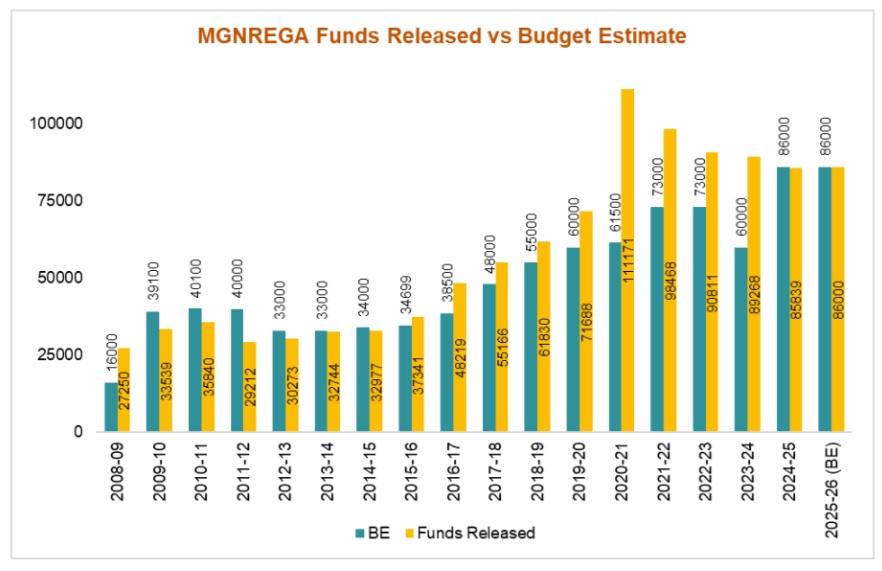
❑ With increased budgetary commitment from Centre over years, but outcomes falling short of desired thresholds, MGNREGA needed the fresh breath of life, mostly a spirited and jan bhagidari led momentum through active participation of local governments viz. Gram Panchayats
❑ With the Central assistance vaulting to Rs 96,000 crore under proposed design in FY27, underscoring continued and substantial fiscal commitment of the Centre...states share will also rise but for the record, 55% of gross tax revenue of Centre (devolution and grants) is also shared with states. States may need to reorient expenditure towards more productive purposes
❑ Using a simulated scenario of normative assessment of (only Centre’s share), with seven attributes/parameters
spread across twin fulcrum of equity and efficiency, we estimate the States gain around Rs 17,000 crores when
compared to average allocation of last 7 years, hinting at a scenario where most of the states will be net gainers
based on the hypothetical weights and inter-se distribution
Increase in nature of works under VB-G RAM G Act should increase average days of employment (stretch goal:
125 days) even when average number days of employment provided per household has gradually increased to
50.4 only from 45.9 (guaranteed days of employment: 100)
❑ Also, the aspirations, with states’ active participation and robust penalty mechanism should ensure dissipating
the persisting gap between work provided and work demanded (around 14% since FY20) as the scheme often
engages in work misaligned with changing economic priorities
❑ Adequate compensation has always been the Achilles' heel of MGNREGA as the rise in compensation in both
absolute as also real term has been patchy over the years, resulting in poor demand-supply equilibrium,
expected to be aligned better now under the revised scheme
