(At Least) Exchange rate needs immediate protective guardrails to thwart speculation
FinTech BizNews Service
Mumbai, 03 October, 2026: The State Bank of India’s Economic Research Department has come out with a Pre-MPC Research Report, as the Committee begins deliberations from October 05 to decide on the policy stance. The report has been authored by Dr. Soumya Kanti Ghosh, Group Chief Economic Advisor, State Bank of India.
Prelude to MPC Meeting: October 5-7, 2026
Amidst an impending global turmoil that may rip aside emerging markets with US yields at 25 year high and destined for even higher levels, RBI set to BEGIN first of the rate hikes by 25 bps (At Least?) in October policy; (At Least) Exchange rate needs immediate protective guardrails to thwart speculation.
October Policy Meet…..RBI to raise rates by 25 bps AT LEAST even as global macros looks poised for a turmoil …..
❑ We believe the balance of risks has tilted decisively towards a 25-bps rate hike at this juncture.... a combination of broadening inflationary pressures, worsening global macros, evolving liquidity conditions and a renewed global repricing of risks is making the case for pre-emptive action stronger
• Firstly, the global environment argues against waiting.... South Korea and the Philippines raised rates in August, followed by the US, Japan, Euro area and New Zealand in September, amid renewed inflationary risks. With geopolitical tensions, crude-price risks and global repricing of risks, it would be prudent for us to rather act pre-emptively than being behind the curve
• Secondly, inflation is becoming increasingly broad-based…CPI inflation rose to 4.82% in Aug’26 from 4.45% in Jul’26, while our analysis shows a clear generalization of price pressures....with a possibility of pass through in future
❑ Rupee, caught in a downward spiral as shown by rapid decline, and strengthening of Dollar Index, in part driven by higher demand from OMCs and select Corporates, heavy demand from a bevy of Foreign Banks and constant pressure from FPI selling since last Friday ($4.45 Bn)... as it slouches towards the figure level of 97 the conviction in RBI’s ability to meaningfully intervene and thwart speculative forces would be litmus test of its, and nation’s, innate strength.. Yields are also likely to move much higher….
❑ Even as rate hike looks imminent, the monsoon story deserves attention...
The 2026 monsoon was the 4th driest since 2000, at just 87% of LPA, with 43% of districts receiving deficient rainfall. Punjab and Bihar received 41% and 32% below-normal rainfall, respectively, while Maharashtra has declared drought across 265 talukas. With low irrigation coverage for crops such as soybean, tur, jowar and bajra, rainfall dependence remains high.... while strong El Niño conditions and below-normal October rainfall could pose further risks to Rabi output.
Fourthly, liquidity is high in headline terms, but effective liquidity creation is much lower under the hood.... Despite record $143.5 bn forex inflows under the special swap facility, regulatory requirements (CRR/SLR/LCR) constrain the deployment of incremental deposits. We estimate that to support an estimated 16% credit growth for FY27 / loans create deposits there will still be a gap of Rs 8.2 lakh crore in deposit creation by banks because of regulatory dispensation, UPI & Sparsh requirements. Hence, going forward system liquidity will automatically adjust and there is no need for additional maneuvering
❑ We believe, an estimated Rs 4 lakh crores of additional cash is floating in the system on account of RBI regulation in April 2025 that has mandated 90% of all ATMs will dispense notes of smaller denomination like Rs 100/200
❑ The Maharashtra Government has officially declared a drought on September 26, 2026, across 265 of the state's 358 talukas (covering roughly 74–75% of the state) due to 19% overall rainfall deficit and prolonged dry spells lasting 21 days or more during the Kharif season. Major crop losses have hit rain-fed crops like soybean, cotton, moong, urad, and sugarcane… We believe the chaotic rain pattern (Drought as also Floods) may nudge many other States to revisit their contingency / Disaster management plans
❑ While India need not press the PANIC BUTTON as of now, Policy Makers and Regulators would do well to brace for an eventuality where evolving macros force resorting to some unconventional rate measures to safeguard broader interests ❑ We also expect RBI to upgrade the GDP forecasts upwards by 30 bps and inflation forecast by 20 bps for FY27…..
Global Economy : The Tales & Travails of Global Uncertainties witnessing Quantum Jump…
The World Uncertainty Index (WUI), tracking economic and political uncertainty across 143 countries, determines ‘uncertainty’ using the frequency of the self-same word in the quarterly Economist Intelligence Unit (EIU) country reports and has been on a roil since Q2’ 2024 with a change in realpolitik anchoring its homerun. The WSI quantifies the overall sentiment by considering the occurrence of positive and negative words in the EIU country reports (net difference normalised) and has been embracing volatility through rapid vortexes
The Costs of ‘Repricing of Risks’ are galloping to Uncharted Highs
US 10 Y yield (5.33% on 30th Sep), the most crucial gauge of global risk-reward matrix, has vaulted through the roof (YTD), tearing through all key resistance levels as global uncertainties deepen materially pressed by concerns that persistent energy-driven inflation could prompt tighter monetary policy while national debts slouch towards unsustainable levels… Most major economies revisit financing costs as interest servicing pains rise
Will the Fed remain Quiet…. How it says, What it needs to say
Warsh Led Fed: the rate path is a credibility referendum, with an embedded Endgame centricity (June’2025
In our June’2026 report, we had anticipated Markets getting Noisy, despite the Fed getting Quiter, forcing the Fed to listen to street’s shrill tunes… With inflation expectations increasingly getting entrenched and a muddled jobs market, rate hike expectations can be a self-fulfilling fallacy as yields across papers indicate
Communication, increasingly, has become monetary policy unto itself
Returns are hitherto driven by Select Equities Markets…. If Debt Yield spikes further, Equities face the Heat
Rate hike among Major Central Banks
❑ The renewed geopolitical tensions in West Asia has continued to weigh on the growth-inflation trade-off faced by central banks across AEs and EMEs ❑ Amidst persistent inflationary risks, South Korea and the Philippines have raised their benchmark interest rates in August, but Australia, India, China, Indonesia, Mexico, Malaysia, Russia and Thailand held their policy rates steady in the last policy
In September, US, Japan and the Euro area raised their policy rates amidst rising inflationary risks. Similarly, New Zealand raised its benchmark interest rate, citing higher fuel prices, while Canada and the UK kept their rates unchanged
INDIA MACROS
CPI inflation may cross 6% in Q3 FY27
❑ India's retail inflation rose to 4.82% in August 2026, up from 4.45% in July, due to broad based increase in almost all divisions
❑ Our study of data till Aug’26, indicates that the process of inflation is getting generalized. In Jan’26, 22 commodities explained 90% of CPI’s weighted contribution. In August this number of commodities increased to 51. Further, the top 25 commodities’ (ex-gold/silver), contribution has declined from 83% in Jan’26 to 62% in Aug’26
❑ The risk of further generalization is particularly pronounced in sectors where input prices are currently rising faster than output prices, suggesting that the pass through has not been enough on producer’s side. This is evident in sectors such as electrical equipment, computer and electronic products, furniture, wood and wood products , metal products , pharmaceuticals and beverages in descending order ❑ While the pass through of rise in crude price remains partial until retail prices are revised, the fiscal implications and pass through proliferate at multiple levers, affecting pricing dynamics and allocation
Going forward, we believe CPI inflation may be at 5.65% in Sep’26 and cross 6.5% mark in Oct and Nov (peak expected in Nov) before dropping to less than 6% in the early 2027
SCBs Notch Up Credit & Deposits Growth
❑ Indian banking sector’s credit grew at a robust pace of 18.1% for the fortnight ended 15 Sep 2026, compared to last year growth of 10.4%, while aggregate deposits grew by 17.3%, compared to last year growth of 9.5% ❑ RBI data showed that cumulative forex inflows under its special USD-INR swap facility reached $143.5 billion as of 18 Sep 2026, led by $132.9 billion through FCNR(B) deposits, $5.3 billion through OFCBs and $5.2 billion through ECBs ❑ Interestingly, SCBs deposits grew by Rs 13.9 lakh crore, while during RBI’s special FCNR (B) window (09 Jun-31 Aug), deposits grew by Rs 17.8 lakh crore…so FCNR (B) deposits helped banks to fund the credit growth
Industry & Personal Loans is contributing to 54% of Incremental Credit Growth
❑ The sectoral incremental credit growth data during Apr-Aug 2026 indicates that ‘industry and personal loans’ has contributed ~54% of the incremental credit growth ❑ Among industry, ‘Infrastructure (especially Power)’, ‘Chemicals’, and ‘All Engineering’ and ‘Vehicles, Vehicle Parts and Transport Equipment’ are contributing ~54% of the incremental industry credit ❑ Among personal loans, 28% (Rs 7981 bn out of Rs 3475 bn) is contributed by ‘loans against gold jewellery’ alone
Weighted Average Lending Rates have Already Increased by 21 bps in the Current FY so far
❑ Weighted Average Lending Rates (WALR) on fresh rupee loans have risen by 21 basis points (bps) in the current fiscal year, signaling a tightening of credit conditions across the banking sector
2026 monsoon is 4th driest season since 2000
Rainfall over the country as a whole during the 2026 southwest monsoon season (June- September) was 87% of its long period average (LPA). All India Summer monsoon rainfall was 759.4 mm which is 4th lowest since 2001 and 13th lowest since 1901 However, the North-West and Central India (which are the major contributor to foodgrains production) are hardly faced any deficit rains
Punjab & Bihar are the driest state….
43% of India’s districts received deficit rains This year among major States, Punjab received the least rainfall (41% less than normal), with 86.4% districts having deficit rains This is followed by Bihar having 32% less rains with 86.8% districts having deficit rains Overall, 43% of India’s districts having deficit rainfall during Monsoon 2026
Drought in Maharashtra: An Early Warning Signal
The Maharashtra Government has officially declared a drought on September 26, 2026, across 265 of the state's 358 talukas (covering roughly 74–75% of the state) due to an 18% overall rainfall deficit and prolonged dry spells lasting 21 days or more during the Kharif season The crisis is most acute in Marathwada (an average 39% rainfall deficit, with Hingoli hitting 49%) and Vidarbha (a 26% deficit). Major crop losses have hit rain-fed crops like soybean, cotton, moong, urad, and sugarcane
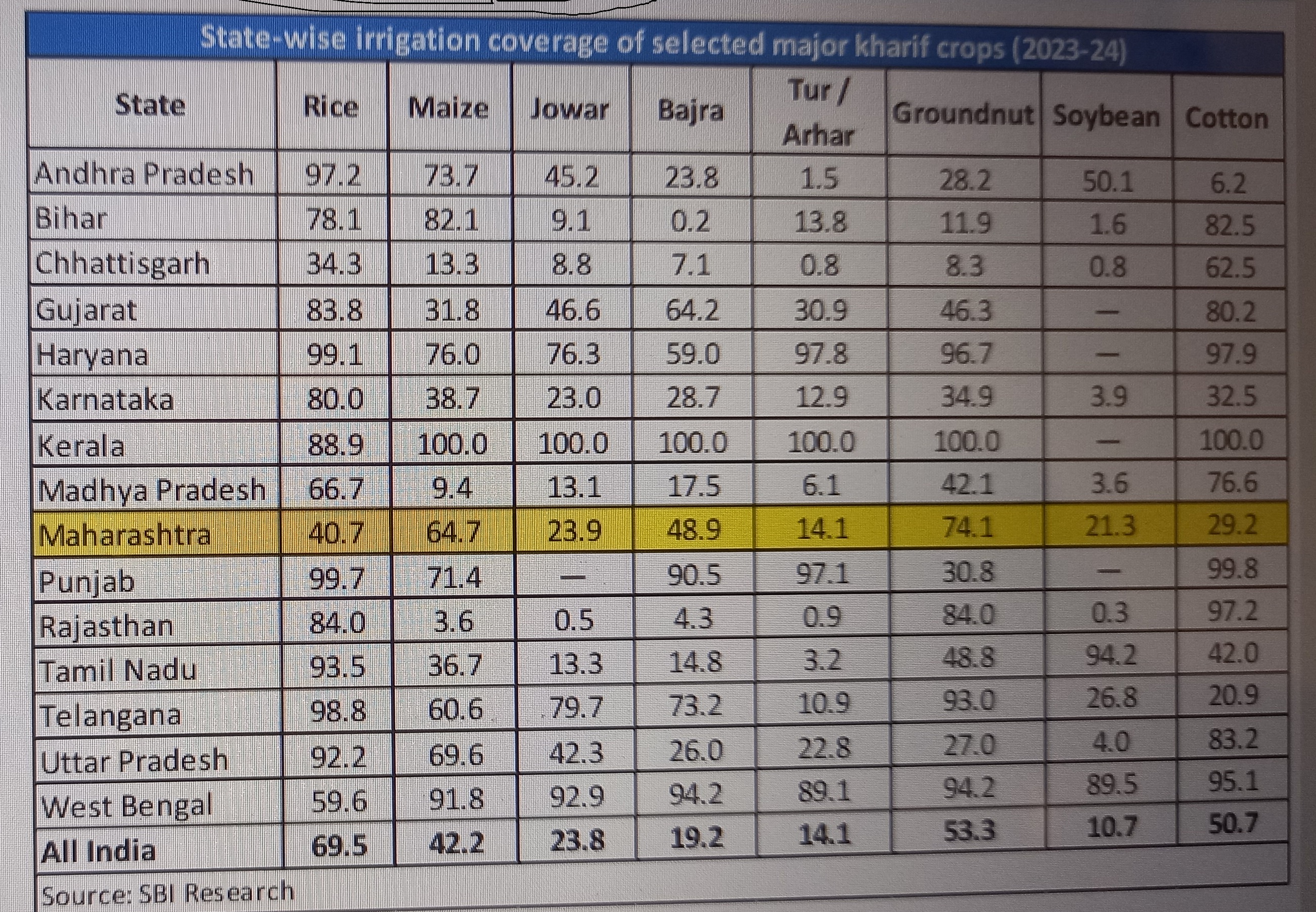
Irrigation coverage of major Kharif Crops lead to….
While irrigation coverage remains broadly adequate for several major kharif crops, gaps persist across crops and states, leaving production vulnerable to rainfall variability For instance, soybean has very low irrigation coverage in Maharashtra (21.3%), Madhya Pradesh (3.6) while tur/arar remains largely rain fed in Madhya Pradesh (6.1%), Andhra (1.5%) and Karnataka (12.9%) Similarly, jowar and bajra show low irrigation coverage in several major producing states. Such dependence on rainfall could amplify the impact of adverse weather on crop output and prices, creating upside risks to food inflation
….better Kharif Sowing despite deficit Monsoon
Kharif sowing (so far) is only 1.2% lower than the 2025 levels indicating better harvest and subsequently minimal/no impact on food inflation going forward However, a late El Niño may impact the Rabi crops
Govt lowers foodgrain production target for 2026-27 due to lower Rabi production
The government recently set a lower foodgrain production target of 373.9 Mn Tons for the 2026-27 year amid low Rabi production due to El Nino weather concerns The overall foodgrain production target is down by 2.6 Mn Tons from the actual production of 376.6 Mn Tons achieved in the 2025-26 year. But the target set for this year is still higher than 2024-25 level
….Rabi crops are going to be impacted by El Niño
As per IMD, strong El Niño conditions are currently prevailing over the equatorial Pacific Ocean, with sea surface temperatures well above average (especially in the east-central and eastern equatorial Pacific) with neutral IOD Consequently, monthly rainfall over the country as a whole during October 2026 is likely to be below normal (<85% of LPA) Government has approved higher Minimum Support Prices (MSPs) for all mandated Rabi crops for the 2027 28 Marketing Season
Liquidity under the hood is a more meaningful description
❑We expect Core Surplus liquidity may fall from 13.9 lakh crore peak as 15 Sep’26 to ~Rs 7 lakh crore as on end Dec 26 and may come down to ~3.5 lakh crore as on End Mar’27 ❑Meanwhile, system liquidity declined to Rs 4.8 lakh crore due to Government cash balances of Rs 9.0 lakh crore
Huge Deposit inflows due to FCNR (B)
❑ While record FCNR(B) inflows are argued to translate into a significant increase in bank deposits and, consequently, system liquidity, we argue that the headline increase in deposits may overstate the effective liquidity creation in the banking system
❑ Banks operate within binding regulatory constraints such as the CRR, Statutory Liquidity Ratio SLR and LCR, which require a portion of incremental resources to be maintained in prescribed liquid assets or with the RBI rather than being deployed as fresh credit
❑ Thus, a more better measure of liquidity / liquidity under the hood for deposit creation and broader monetary expansion could be considerably more muted once these regulatory requirements are accounted for
❑ We believe that this would automatically lead to liquidity normalization going forward
Regulatory requirements dampen operating multiplier…
❑ We firmly believe that the operating multiplier is way below the RBI’s 6.15 (2026) due to : 1. Shifting of HHs/Retail deposits towards FI deposits (that will attract 100% run-off factor as compared to merely 5%-10% in case of retail deposits) 2. Impact of SNA-Sparsh 3. Impact of UPI
❑ We estimate that to support an assumed credit growth of 16% for FY27 (incremental credit: Rs 34 lakh crore), the system deposit requirement due to regulatory dispensation in the form of CRR/SLR/LCR and Sparsh and UPI, is still falling short by Rs 8.2 lakh crores, even after the FCNR deluge. Hence, going forward system liquidity will automatically adjust and there is no need for additional maneuvering
