82% of respondents believe that digital tools and access to affordable credit make it easier to achieve financial goals.
FinTech BizNews Service
Mumbai, 20 August, 2026: Home Credit India, a leading consumer finance company, today unveiled the findings of the fourth edition of its annual report, The Great Indian Wallet 2026, themed ‘From Tax relief to tangible choices - how India’s wallets are being reshaped’. The GIW 4.0 study reveals a notable shift in consumer sentiment, driven by greater access to credit and the financial relief following GST reforms. Together, these factors have eased the burden of everyday household expenses, strengthened financial confidence, and reinforced prioritisation of homeownership as the foremost long-term financial goal.
“When we initiated 'The Great Indian Wallet Study' in 2023, we sought to understand the financial pulse of India. What we discovered was a purpose driven and financially prudent nation,” said Ashish Tiwari, Chief Marketing & People Officer, Home Credit India. “This year's findings reveal something extraordinary. Despite economic headwinds, the tangible relief brought on by post-GST price revisions, paired with structured financial tools, is smoothing their path toward wealth creation and entrepreneurial expansion.”
Gauging India’s Financial Pulse: Optimism Amid Structural Adjustment
Home Credit India's proprietary Financial Well-Being Index reveals a rise to 40 points in 2026, its highest level since the study began in 2023 driven by sharp jumps in savings and investment scores this Index has ever recorded, up from 34 points the previous year. This improvement was led by savings and investments, which registered the sharpest gains compared to last year, pointing to stronger asset-building capacity. Overall, 85% of consumers express absolute confidence in achieving their personal financial goals within the next five years, while 87% remain hopeful that their broader financial situation will improve.
The Post-GST Paradigm: Policy Alleviating Everyday Pressures
A critical focal point of the GIW 4.0 study is how GST tax shifts have trickled down into household economics.
The Balancing Act: Shifting Wallet Shares and Household Dynamics
The lower-middle-class wallet operates on a delicate balance, maintaining an average monthly income of Rs35,000 against essential expenses of Rs21,000. Financial responsibility is increasingly shared across generations, with Gen X contributing an average of 70% of household expenses, followed by Millennials at 68% and Gen Z at 57%. Males too are one of the highest contributors at 67% as compared to 52% females. Gen Z leads every generation in saving at 58%, followed by Millennials at 53%, while Gen X trails meaningfully at 44% because of higher household responsibility.
Regional variations remain pronounced. Metropolitan residents register the highest income thresholds (Rs38,000) alongside elevated living costs (Rs22,000). Conversely, Tier-1 residents report lower average incomes (Rs33,000) matched by tighter, downscaled expenses (Rs20,000).
Aspirations of Wealth Creation: Real Estate, Business, and Advice
Savings and Investments scores are at 31 for the current year, up from 23 and 17 respectively compared to last year. The increase in savings and investment shifts from impulsive purchases toward longer-term asset building such as 31% wanting to buy a house. However, local travel and sightseeing remain the most common discretionary indulgence (26% of respondents) while reflecting a strong inkling towards other outdoor experiences with 22% Gen Z’s indulging in watching movies and 27% traveling outstation and eating outside.
The lower-middle-class consumer is focusing on permanent goals:
retail segments.
• Psychological De-stressing: The stabilisation of daily costs has yielded significant psychological benefits. Half of all respondents (50%) state that managing household expenses has become distinctly less stressful, and 47% report that handling emergency expenses has become easier. As a result, 63% feel more confident about working towards their future goals, and 62% feel more confident using credit or EMIs for planned, important purchases.
The Balancing Act: Shifting Wallet Shares and Household Dynamics
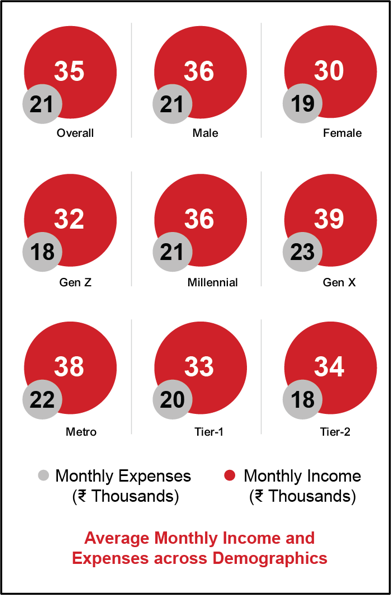
The lower-middle-class wallet operates on a delicate balance, maintaining an average monthly income of Rs35,000 against essential expenses of Rs21,000. Financial responsibility is increasingly shared across generations, with Gen X contributing an average of 70% of household expenses, followed by Millennials at 68% and Gen Z at 57%. Males too are one of the highest contributors at 67% as compared to 52% females. Gen Z leads every generation in saving at 58%, followed by Millennials at 53%, while Gen X trails meaningfully at 44% because of higher household responsibility.
Regional variations remain pronounced. Metropolitan residents register the highest income thresholds (Rs38,000) alongside elevated living costs (Rs22,000). Conversely, Tier-1 residents report lower average incomes (Rs33,000) matched by tighter, downscaled expenses (Rs20,000).
Aspirations of Wealth Creation: Real Estate, Business, and Advice
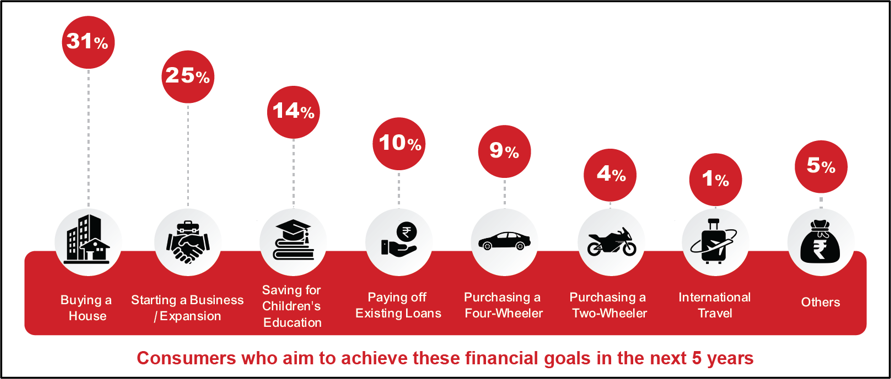
Savings and Investments scores are at 31 for the current year, up from 23 and 17 respectively compared to last year. The increase in savings and investment shifts from impulsive purchases toward longer-term asset building such as 31% wanting to buy a house. However, local travel and sightseeing remain the most common discretionary indulgence (26% of respondents) while reflecting a strong inkling towards other outdoor experiences with 22% Gen Z’s indulging in watching movies and 27% traveling outstation and eating outside.
The lower-middle-class consumer is focusing on permanent goals:
• Homeownership: Buying a house remains the top financial goal over the next five years and has gained momentum compared to last year, particularly among women at 40%
• Micro-Entrepreneurship: 25% of respondents intend to start a new business or pursue an expansion within the same timeframe, with entrepreneurial intent continuing to grow steadily even as shorter-term consumption goals such as vehicle purchases and international travel soften.
• The most aspiring youth: Entrepreneurial ambition, skews younger and more male - Gen Z leads at 31%, compared to just 19% among Gen X, and men (26%) outpace women (20%).
As consumers become more intentional about aligning their aspirations with their budgets, the need for informed financial decision-making continues to grow. The study reveals that 57% of respondents are seeking professional financial advice to better manage their finances, while 82% identify affordable access to credit as the most important enabler of financial security. These findings underscore a significant opportunity for financial institutions to complement responsible credit solutions with tailored financial education, empowering consumers to make confident, well-informed financial choices and achieve their long-term goals.
Digital Tools and Smart Credit as Strategic Enablers
Technology continues to act essential for economic mobility. 82% respondents’ credit digital tools for accelerating their goals, with adoption and confidence strongest among Gen Z (86%), Males (84%) and Tier-1 (92%) residents. Offline channels still dominate purchases of essentials and durables such as groceries (82%), mobiles (81%) and appliances (80%), but digital adoption is strongest for payments (49%) and taking loans (51%) pointing to growing trust in financial technology.
The Great Indian Wallet 4.0 study was conducted with borrowers aged 18-55 years, across 17 major Indian cities and varied income groups and professions.
