What began as a $918 million deal in 2008 scaled to $2.55 billion for 2018–2022, before surging to $6.2 billion for the 2023–2027 cycle. This implies an approximate 18% CAGR

FinTech BizNews Service
Mumbai, April 3, 2026: The Kotak Mutual Fund has come out with an interesting research report, which focuses on the Economics of Indian Premier League.
How a Two-Month Tournament Became One of the World’s Most Valuable Sports Businesses?
Can a sporting event that lasts barely eight weeks rival leagues built over decades? The Indian Premier League (IPL) answers that question decisively.
In under 20 years, the IPL has grown into a sporting ecosystem valued at approximately USD 18 billion (FY25) placing it among the popular commercial leagues globally. What makes this remarkable is not just its scale, but its efficiency: a two-month tournament anchoring value comparable to India’s entire sports industry, currently estimated at USD 19 billion and projected to more than double by 2030
Source: KPMG
 Source: JM Financial
Launched in 2008, the IPL was not merely a cricketing innovation, but a business model tailored to India’s consumption patterns. By combining a fast-paced T20 format with city-based franchises and entertainment-driven storytelling, it transformed cricket into a year-round commercial platform. Today, the IPL monetizes attention across media, sponsorships, digital ecosystems, and live experiences—functioning less like a tournament and more like a multi-asset business.
From Entertainment Property to Economic Contributor
The IPL’s rise is not confined to valuations; it is increasingly visible in macroeconomic terms.
Few sporting properties demonstrate such a wide economic footprint across sectors.
Source: JM Financial; KPMG; PvtCourt, StartUpTalky , ET Edge Insights, IOSR Journal Of Economics and Finance (IOSR-JEF)
Media Rights: The Flywheel of Growth
At the heart of IPL’s commercial success lies its media rights engine.
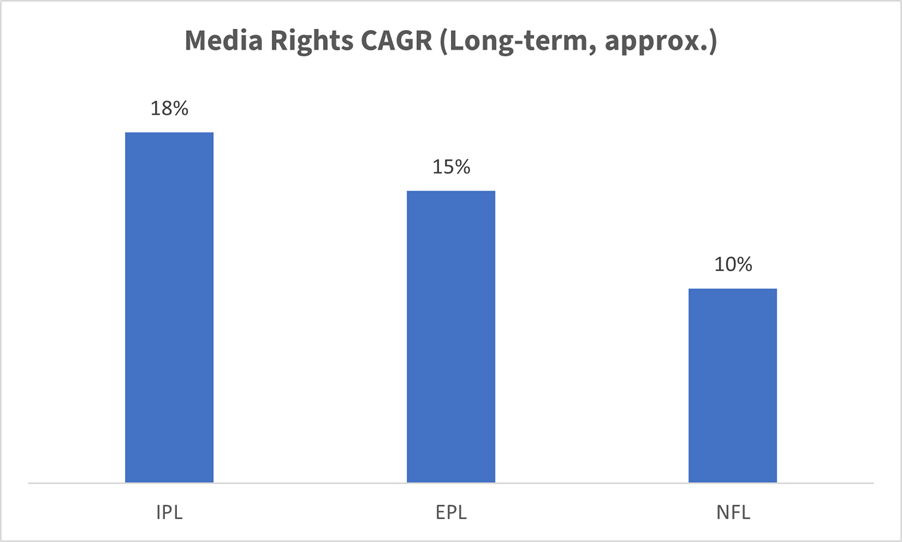
What began as a $918 million deal in 2008 scaled to $2.55 billion for 2018–2022, before surging to $6.2 billion for the 2023–2027 cycle. This implies an approximate 18% CAGR, outpacing established leagues such as the English Premier League (EPL) (~15%) and the National Football League (NFL) (10%)
Source: BCCI Reports, Forbes India, JM Financial; KPMG
Yet, the real story lies in how this value is being unlocked. The IPL now reaches ~1 billion viewers across TV and digital platforms, with 600–650 million unique viewers in recent seasons. Digital consumption has accelerated sharply, with 1.37 billion views recorded during the opening weekend of IPL 2025 alone. This scale is translating into monetization, with advertising revenues projected at ~USD 600 million in 2025, a nearly 50% year-on-year increase
Source: LiveMint; JM Financial; KPMG
The consolidation of broadcast and streaming under the JioHotStar platform marks another structural shift—blurring the lines between television and digital. In effect, the IPL is no longer just a broadcaster’s asset; it is a technology-led media ecosystem built on mobile-first consumption, regional content, and data-driven engagement.
Franchises: Sport Meets Structured Finance
Behind the spectacle lies a tightly engineered financial model.
Unlike most global leagues, the IPL operates as a closed system—with no relegation risk and guaranteed annual participation. More importantly, over 70% of franchise revenues are derived from centrally shared media rights and sponsorship pools, with only limited dependence on on-field performance.
The result is a rare construction in sports: predictable, annuity-like cash flows. This reduces earnings volatility and elevates franchises from sporting entities to institutional-grade assets (Source: D&P Advisory; JM Financial). In financial terms, IPL teams increasingly resemble infrastructure assets more than traditional sports clubs.
Source: D&P Advisory; JM Finance
A Story of Resilience
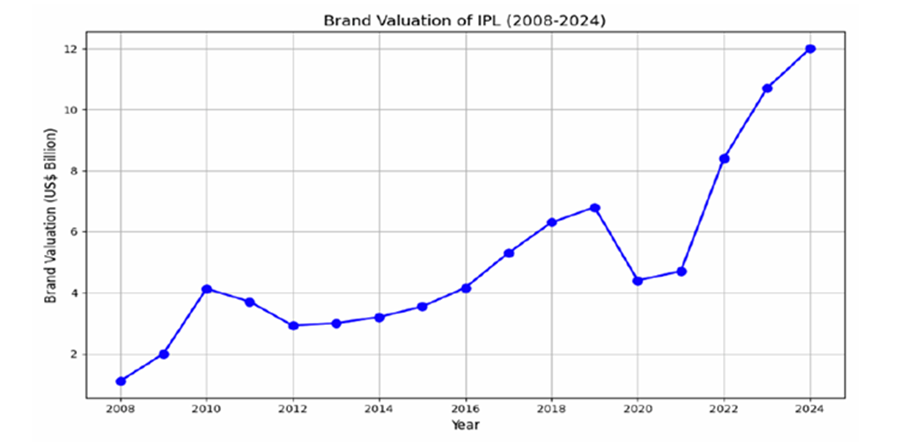
The IPL’s valuation journey underscores both its growth potential and its resilience.
From $1.1 billion in 2008, the league rapidly scaled to $4.13 billion by 2010, before governance challenges triggered a decline to $3.7 billion in 2011. Growth resumed steadily, with valuations reaching $6.8 billion by 2019. The pandemic-induced disruption led to a 22% decline to $4.4 billion in 2020, but the recovery was swift—$8.4 billion in 2022, crossing $10 billion in 2023, and reaching ~$12 billion in 2024
 Source: IOSR Journal of Economics and Finance (IOSR-JEF)
Beyond Broadcast: A Diversified Revenue Model
While media rights remain the anchor, the IPL’s revenue model is increasingly diversified.
Advertising revenues have expanded from Rs350 crore in 2008 to an estimated Rs6,000–7,000 crore by 2025. Title sponsorship has seen a similar jump—from Rs40 crore (DLF era) to Rs500 crore (Tata, from 2024). Franchise-level sponsorships now contribute around Rs1,300 crore, with leading teams earning Rs100–150 crore each
Source: KPMG; JM Financial
Source: KPMG
Crucially, the league has built structural cost discipline through its auction-based player system, which enforces salary caps and transparent price discovery. This prevents wage inflation—a persistent issue in global sports—and ensures that player costs remain aligned with revenues.
The IPL Multiplier: Impact Across the Economy
The IPL’s real significance lies in its spillover effects.
In tourism and hospitality, it generates approximately 45,000 room nights annually, with hotel occupancy in host cities often exceeding 90% during the season. IPL 2019 alone drove nearly 4 lakh tourist arrivals and $68 million in hospitality revenue, while IPL 2024 is estimated to have generated around $450 million. Travel demand has surged by 60–70% during peak months
Source: Business Standard; MARC Insights; Our Business Ladder
In advertising, the IPL has become a premium platform, with ad rates scaling sharply in line with viewership. Globally, it ranks among the top leagues in sponsorship revenue, reflecting its strong brand equity
Source: Cronin & Cronin, 2025
The employment impact is equally significant. The Economic Survey estimates over 20,000 seasonal jobs annually, while an IIM Bangalore study suggests over 4 million jobs were created in 2019, spanning media, logistics, hospitality, and operations
Source: MarketingStuff.in, 2024
The table below is from the article “How IPL Contributes to India’s GDP Growth: A Deep Dive into the Economic Impact”
SectorIPL-related Jobs Created
Sports Management and Operations | 32,000 |
Media and Broadcasting | 25,000 |
Hospitality and Tourism | 45,000 |
Logistics and Event Management | 18,000 |
Ancillary Services | 35,000 |
Source: MarketingStuff.in
The consumption boost is visible at multiple levels. The sports merchandise market, valued at $1 billion in 2023, derives around 40% from IPL-related demand. E-commerce sales rise by 25%, while food delivery platforms report 40–50% spikes during matches, with each game generating roughly $100,000 in stadium F&B revenue.
Source: Deloitte; Our Business Ladder
At the same time, the IPL is deeply embedded in India’s digital economy. With over 500 million viewers in 2024, it is a major driver of growth in fantasy sports, digital advertising, and content ecosystems—sectors that are increasingly central to India’s GDP outlook
Source: Reuters; ET Bureau
Matchday Economics: The City Effect
Even though matchday revenues account for less than 10% of franchise income, their local economic impact is significant.
Match days trigger a 30–70% surge in travel demand, push hotel occupancy to 90–100%, and drive 20–30% increases in room rates. This translates into higher spending across airlines, transport, restaurants, and retail, while also generating temporary employment across sectors
Source: ET Travel World; Fortune India; Business Standard
Over time, the IPL has turned host cities into recurring economic hubs, supporting infrastructure development and strengthening India’s sports tourism ecosystem.
A Blueprint for Global Sports
The IPL’s influence now extends well beyond India. Its franchise-based, media-first model has inspired leagues such as the Big Bash League, Caribbean Premier League, and Major League Cricket. With growing international audiences and diaspora engagement, it is increasingly seen as a replicable blueprint for modern sports leagues
Source: JM Financial; KPMG
Archit Varshney, Senior Manager – Equity Research, Kotak Mahindra AMC says “The IPL has shown how a two‑month tournament can become a year‑round sports platform, monetizing attention across broadcast, streaming, sponsorships and live experiences, not just match outcomes. With $18.5bn in business valuation and a $6.2bn media-rights cycle underpinning its economics, the model now resembles a high-quality media franchise more than a seasonal event amplified by digital scale that delivered 1.37bn views in an opening weekend of IPL 2025 and $600mn in 2025 TV+ digital advertising.”
Source: Reuters, BCCI, Business Standard, ET estimates
Conclusion: More Than a League
The IPL’s success lies in its ability to combine three critical elements—financial discipline, scalable monetization, and deep fan engagement—within a single framework.
It is no longer just a cricket tournament. It is a multi-sector economic engine, a media powerhouse, and a case study in modern sports economics.
In an era defined by fragmented attention and digital disruption, the IPL stands out as a rare asset that continues to scale—efficiently, consistently, and globally. And if the past decade is any indication, its may be one of most valuable innings may still lie ahead.
