A Kotak Mutual Fund Report: From Your Morning Brew to Your Evening Dram
FinTech BizNews Service
Mumbai, 10 January 2026: Kotak Mutual Fund has come out with an interesting research report titled "From Chai to High: India's Beverage Battle."
Right now, as you read this, you are likely holding a cup of tea or coffee. It is the fuel that kickstarts the Indian economy. Fast forward 12 hours to 8 PM tonight, and millions of those same hands will be holding a glass of whisky, gin, or beer to wind down the week.
Between that morning caffeine kick and that evening spirit lies one of the most ruthless, high-stakes arenas in global business: The Indian Beverage Industry.
We are looking at a behemoth market valued at USD 80.11 billion today, projected to nearly double to USD 154.67 billion by 2035, growing at a CAGR of 6.8%^. But these headline numbers are just the tip of the iceberg. Beneath the surface lies a chaotic war for a very specific piece of real estate: Your Throat.
This isn't just about thirst. It's about a structural shift in how 1.4 billion people consume liquids. From the ₹10 hydration stop in a rural village to the premium evening mixer in a metropolitan bar, the industry is bifurcating into two distinct economic realities.
(^source: ICICI securities)
Here is the analysis of what is actually happening in India's liquid economy.
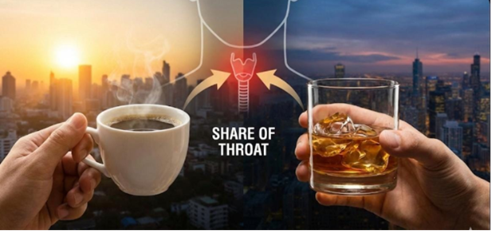
1. The Core Concept: "Share of Throat"
To understand this industry, you have to stop thinking about "brands" and start thinking about biology.
Industry insiders don't just fight for market share; they fight for "Share of Throat." The logic is brutal: Every human being has a finite capacity for liquid consumption per day (approx. 2-3 liters). Every sip of tap water, every cup of homemade chai, and every glass of buttermilk is a "lost opportunity" for a commercial beverage company.
The Goal: To replace every non-commercial sip (tap water, home-brew) with a commercial SKU i.e. Storage Keeping Unit (packaged water, RTD i.e. Ready To Drink coffee, cola).
This obsession with "Share of Throat" explains why a conglomerate like Reliance isn't just launching a cola; they are launching an entire ecosystem to capture every occasion.
Brands are not just selling beverages, they’re vying to become an integral part of daily routines. Companies are innovating with new formats, flavours, and price points to ensure their products are present at every possible drinking occasion. The “share of throat” mindset is reshaping marketing strategies, driving investments in both mass-market and premium segments, and pushing brands to capture even the smallest fraction of your daily intake.
Global Context Comparison:
Globally, non-alcoholic beverages account for over 50% of the total beverage market sales. India mirrors this but with a twist: our "unorganized" non-alcoholic consumption (tea stalls, juice vendors) is massive, meaning the commercial opportunity for conversion is far higher than in saturated Western markets. In alcohol, India is a global outlier. While the world drinks less (global volumes down 1%), India is drinking more (volumes up 7%), positioning it as the primary growth engine for global spirits giants.
Source: Technopak
2. Market Architecture: The Alcohol vs. Non-Alcohol Split
The USD 80.11 billion market is not monolith. It is split into two powerful, yet distinct, empires. Let’s break down the math to see exactly where the money is flowing.
A: The Alcoholic Powerhouse (~USD 47–55 billion)
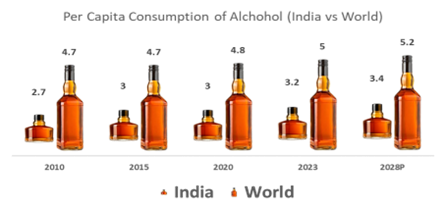
Source: Technopak Analysis, Company, JM Financial
If non-alcoholic beverages are the engine of daily life, alcoholic drinks are the fuel for celebration, status, and social connection. With a market size approaching USD 50 billion, this segment is all about value, aspiration, and evolving tastes.
The IMFL (The Indian-Made Foreign Liquor) segment can be divided into two segments: Brown (whisky, rum, brandy) and white spirits (vodka, gin, tequila). India is predominantly a brown spirit market, which accounts for 96%% of the overall industry volume^.

Source: Technopak Analysis, Company, JM Financial. Note: The above data pertains to FY23.
But it’s not just about quantity, premiumization is driving consumers to trade up, seeking better brands and richer experiences.
Beer: The volume challenger, beer is the drink of choice in urban pockets, college campuses, and summer evenings. While its revenue share trails spirits, beer’s sheer volume and cultural resonance make it a formidable force, especially as craft and flavoured variants gain popularity.
Wine: The aspirational niche, wine is still a tiny fraction of the market (less than 2%), but its growth is explosive in urban centers. Among women and younger demographics, wine is becoming a symbol of sophistication and global exposure, with new vineyards and boutique labels popping up across the country.
The Friday Evening "Drink-flation"
Now, let's look at what happens at 8 PM tonight. While the world is sobering up, India is just getting started—but with a twist.
The Global Trend: Globally, Total Beverage Alcohol (TBA) volumes are shrinking or flatlining (-1% in H1 2025) as health-conscious Gen Z consumers in the West shift away from booze or towards "No-Lo" (No and Low Alcohol) alternatives.
Source: IWSR
The Indian Exception: India is defying global gravity, but not by drinking more cheap liquor. We are drinking better liquor.
Did You Know? The "Premiumization" Paradox

Source: KPMG
B: The Non-Alcoholic Juggernaut (USD 32–35 billion)
The non-alcoholic segment isn’t just the largest by volume, it’s the heartbeat of India’s daily liquid economy. With a market valued at over USD 32 billion in 2024 and set to double by 2033, this sector fuels everything from morning commutes to late-night study sessions. It’s where tradition meets innovation, and where every sip tells a story of changing lifestyles.
The Regional Chessboard: Why India Isn’t One Market?
India’s beverage industry isn’t a single battlefield—it’s a thousand skirmishes. While national giants dominate headlines, local champions often rule their home turf.
Take Gujarat: Here, Wagh Bakri tea commands a staggering 55–60% market share^, outmuscling Hindustan Unilever Limited and Tata Tea. In Tamil Nadu, filter coffee isn’t just a drink—it’s a cultural ritual. North India swears by lassi and buttermilk during summer, while Maharashtra’s urban youth are driving RTD coffee growth.
For brands, this means one-size-fits-all strategies fail. Winning India’s “Share of Throat” requires mastering regional taste maps as much as national trends.
Source: ^Company data
The Cola Wars: The Duopoly Has Hemorrhaged
For twenty years, the "Share of Throat" in the soft drink market was a predictable game of tennis between Coca-Cola and PepsiCo. That game has officially ended.
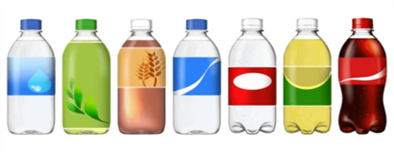
The Disruption: Reliance Consumer Products Limited (RCPL) revived Campa Cola and positioned at the ₹10 price point. While global giants were pushing 250ml boflles for ₹20 to protect margins, Campa offered 200ml for ₹10.
The Result: The 8% Market Share Erosion
The Shock: Between January and September 2025, the combined market share of the Coca Cola and PepsiCo duopoly slipped from 93% to approximately 85%.
The Winner: Emerging players, led by Campa and regional disruptors like Lahori Zeera, have captured a combined 15% share of the market in record time.
Contextual Comparison: This is a "Jio moment" for beverages. Just as telecom incumbents bled market share when data prices crashed, beverage incumbents are bleeding volume as the entry-level price floor collapses. In global markets, established duopolies rarely lose more than 1-2% share annually; an 8% swing in less than a year is a structural disruption.
(Sources: ET, TOI)
The Coffee Paradox: We Grow It, We Don't Drink It
As you sip your morning coffee, consider this: You are a statistical anomaly.
India is a global coffee powerhouse, yet domestic consumption numbers reveal a stunning disconnect. We often confuse the visibility of coffee chains with actual national consumption.
Myth Buster: "India's Café Culture Means We Are a Coffee Nation"
The Myth: With a Starbucks, Blue Tokai, or Third Wave Coffee on every corner, India must be consuming massive amounts of coffee.
The Reality: India is a producer, not a consumer. We grow world-class beans, but we export them.
The Data: Despite being the world's seventh-largest coffee producer, India's per capita coffee consumption is a measly 0.07 kg per year.
The Comparison: The global average is 1.3 kg. That means the average global citizen consumes 18.5 times more coffee than the average Indian.
Context: To put this in perspective, a citizen of Luxembourg drinks about 5 cups per day, while the average Indian drinks approximately 20 cups per year. The "café culture" is a thin, urban layer atop a massive tea-drinking foundation (consuming 750,000 tonnes of tea vs. just 91,000 tonnes of coffee).
The Investment Thesis: This gap is the opportunity. The aggressive expansion of café chains isn't about serving existing demand; it's about forcing a generational habit change to close that 18.5x gap.
Source: Industry data, Coffee intelligence. The brands mentioned in this slide do not constitute any recommendation and Kotak Mahindra Mutual Fund may or may not have any future position in these brands.
The Verdict: The Two Indias
As you move from your morning brew to your evening drink, remember that this industry is telling the story of two Indias:
The USD 80 billion opportunity doesn't lie in the middle. It lies in mastering both extremes: The Rs10 hydration for the heat, and the premium pour for the high.
Mr. Devender Singhal, Fund Manager & Executive Vice President, Kotak Mahindra AMC adds, “ India’s liquid economy is a day–night barbell: mass‑value hydration converts informal sips by day to premium spirits and artisanal coffee experiences by night. Price‑pack resets are loosening the cola duopoly. Wellness‑centric drinks, RTD and packaged water scale on health and convenience and regional tastes win. In alcohol, India drinks better, not just more. Premium‑and‑above spirits lead, beer is the urban volume engine, and portfolios still navigate a state‑by‑state regulatory chessboard.”
