Fed Hikes for First Time Since 2023, Signals One More Move This Year

FinTech BizNews Service
Mumbai, 16 September, 2026: Experts from AMCs, full-service financial services providers and stock broking companies have focused on the latest FED announcement to hike the target range for the federal funds rate by 25bps:
Ashish Rajodiya, Head – Commodities, PL Capita
The Federal Reserve raised interest rates by 25 basis points to 3.75-4.00% on Wednesday, its first hike since 2023, with Chair Kevin Warsh saying "the plain fact is that inflation is too high and has been for too long" and framing the move as securing a timelier return to the central bank's 2% goal. Most policymakers now see the federal funds rate at 4.1% by the end of 2026, implying one further 25 basis point hike this year, with the median holding flat through 2027 — a path of one more move followed by an extended pause rather than a sustained tightening cycle. Warsh pushed back on the idea that lowering inflation requires economic pain, saying he does not believe the Fed needs "to do harm to the labor markets to achieve our objective," but gave no signal on timing. Attention now shifts to the October meeting and the inflation prints in between, leaving rate-sensitive assets such as gold and silver exposed to sharper swings around the data.
Abhishek KS, Fund Manager – Fixed Income, Abakkus Mutual Fund:

"The Fed's decision to raise rates by 25 bps underscores its commitment to securing a timelier return of inflation to target. With economic growth and labour market conditions remaining robust, the Committee has signalled that restoring price stability remains its foremost priority, even amid elevated geopolitical uncertainty."
Sreejith Balasubramanian, Senior Economist – Fixed Income, Bandhan AMC:
The US FOMC unanimously decided yesterday to hike the target range for the federal funds rate by 25bps, in line with market expectations, citing persistently high inflation and the need to support a timelier return to the 2% goal amid robust economic activity and a stable labour market. The Fed Chair described the hike as removal of a dose of accommodative financial conditions. Median projections now reflect one more hike this year and a hold next year (vs. June projection of 1 hike in 2026 and reversal in 2027), with inflation risks to the upside and labour risks roughly balanced.
10y-2y US treasury yield spread has eased while the USD has Risen
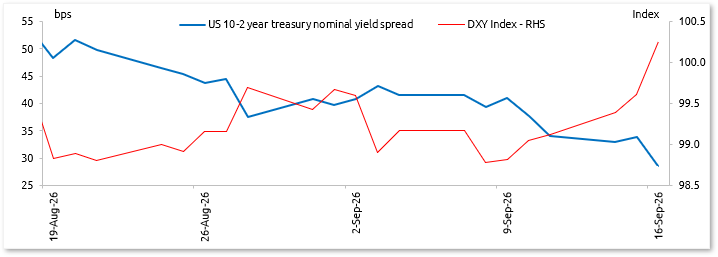
Fed rate hike expectations had increased in the last three weeks, following the Fed Chair’s late-August statement about its predominant focus on prices, robust job additions and higher Core CPI in August, and higher oil prices. Longer term yields have also been rising given fiscal, growth surprises and high AI debt-financing. The 10y-2y treasury yield spread has thus been easing, and the dollar has moved up (Figure 1).
The Fed and ECB have hiked rates and markets expect them to hike again this year and the Bank of Japan (BoJ) to hike this week. Alongside rising global rates, inflationary pressures in India have also been rising due to higher oil and global commodity prices, below normal and uneven monsoon rainfall, buoyant GDP and strong credit growth. However, India’s monetary policy setting has incrementally loosened of late. We therefore expect the RBI to deploy a combination of temporary and permanent measures to absorb the excess liquidity from its recent special swap schemes, and to hike policy rates by 75bps by April next year.
Apoorva Javadekar, Chief Economist, Shriram Group and CEO, Shriram Research.
“The Fed’s 25-bps hike appears to mark the start of a prolonged tightening cycle. While US yields surged, inflation expectations fell, suggesting the hike reinforced the Fed’s inflation-fighting credibility. Indian yields remain vulnerable to higher US yields. We believe RBI rate hikes would be an inefficient tool to defend the INR, as the resulting drag on growth could itself weaken the currency over the medium term.”
Sonam Srivastava, Founder & CEO, Wright Research:
“I found the Fed's latest rate hike quite interesting, not so much for the 25 basis points itself, but for what it’s trying to tell us. This is the first hike since 2023, and it’s really a response to oil-driven inflation after the Iran conflict. Headline CPI is back at 3.4%, core at 2.4% - both still above where the Fed is comfortable. Chair Warsh has made it very clear that they want to get back to 2% inflation faster, so this probably isn’t just a one-off move. Markets are already starting to price in another one or two hikes before the year is out, and that’s something every emerging market, including us in India, has to pay attention to.
For Indian equities, the reaction has been pretty calm so far - no real panic, since everyone more or less expected this hike. Nifty is still holding above 23,200, which is quite robust. But the real story is in the rupee and the cost of capital. When the Fed stays higher for longer, the dollar starts looking more attractive than Indian assets, and with crude prices still elevated, that puts steady pressure on our currency and the import bill. We’ve already seen foreign investors turning net sellers in Indian equities through September, and usually, that trend continues when US real yields go up and the rate gap between India and the US gets lesser.
Whenever US yields move up, you almost always see valuation multiples for growth and long-duration sectors come under pressure. So I’d expect some rotation out of the expensive stuff and into businesses with visible earnings and real pricing power - think domestic consumption and financials that aren’t as exposed to global capital flows. For long-term investors like us, the real discipline isn’t about guessing the Fed’s next move. It’s about building portfolios that don’t need a friendly rate environment to do well. That means sticking with quality, cash-generative businesses, staying diversified across market caps instead of chasing momentum, and treating currency and rate swings as risks to manage through allocation, not something you can time perfectly. Systematic, factor-based strategies are actually quite useful in times like this, because they quietly shift you toward what’s working, instead of getting stuck on a story about where rates should go.”
Anil Rego, Founder & CIO, Right Horizons:
“The Fed’s 25-bps rate hike and indication of further tightening have strengthened the dollar and kept global bond yields elevated. For India, this could result in some near-term volatility in FPI flows and the currency, with the rupee moving beyond ₹96/$ following the Fed decision. However, India’s resilient domestic growth, corporate earnings and strong domestic liquidity should provide a meaningful cushion against global volatility.
Crude is currently a more important macro variable, with Brent trading around $105–106/bbl. Sustained crude prices above $100/bbl would need to be monitored given India’s dependence on energy imports and the potential impact on inflation, the current account and the rupee. The recent easing in crude from its highs is therefore encouraging, although geopolitical developments remain important.
For Indian equities, we see these factors as near-term headwinds rather than a change in the medium-term growth outlook. Higher global yields could lead to some valuation moderation, particularly in expensive segments, but this can also create opportunities in fundamentally strong companies. From a portfolio perspective, the focus remains on earnings visibility, healthy balance sheets and reasonable valuations, complemented by diversification and appropriate hedging to manage periods of elevated volatility.”
Shashank Udupa, SEBI-Registered Research Analyst:
“What does the Fed’s September rate decision mean for Indian markets?
The Fed’s 25 bps rate hike to 3.75%-4.00% is important because it is the first hike since 2023.
This is mainly due to higher energy prices, with crude staying above $100 amid Middle East tensions, while the US labour market is still strong enough for the Fed to keep rates higher.
The Fed’s dot plot also shows a divided view for 2027. Some members expect another hike, some expect rates to stay where they are, while others see cuts.
The rate path is going to remain uncertain, and markets should expect more volatility.
For India, we are already seeing the impact. FPIs have pulled around Rs13,000 crore from Indian equities in the first half of September, after two months of inflows in July and August.
The combination of a stronger dollar + higher US bond yields + expensive crude is putting pressure on emerging markets globally.
For Indian markets, the biggest risk is that higher US yields make emerging-market equities less attractive, especially stocks where valuations are high but earnings growth has not caught up.
The rupee is another pressure point. A stronger dollar and crude above $100 are a bad combination for India because our oil import bill goes up, which can widen the trade deficit and put pressure on the rupee.
The RBI may continue to manage this through intervention rather than aggressively changing domestic rates, especially when domestic inflation remains relatively comfortable.
So, what should investors focus on?
Quality matters more: In a higher-rate environment, companies with strong cash flows, healthy balance sheets, and visible earnings become more important than businesses valued purely on future growth.
Foreign money can move very quickly when global yields rise. But India's domestic flows through SIPs, insurance, and EPFO have become a much bigger support for the market.
Periods of global volatility can create opportunities. Instead of trying to predict where the market will bottom, it may make more sense to keep some dry powder and look for quality businesses when valuations become more reasonable.
To me, the key takeaway is that the next few months could remain volatile, but volatility itself is not the problem. The bigger question is where earnings and valuations stand once the global rate cycle becomes clearer.”
