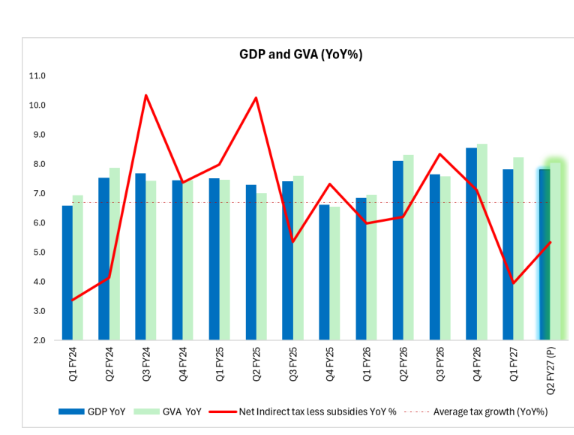
GDP Growth for Q2 FY27 at 7.8% (RBI: 7.2%): Nominal GDP at 11-11.5%..GVA growth to cross 8%..
FinTech BizNews Service
Mumbai, 11 November, 2026: The State Bank of India’s Economic Research Department has come out with a Pre-GDP Q2FY27 Research Report. The report has been authored by Dr. Soumya Kanti Ghosh, Group Chief Economic Advisor, State Bank of India.
Despite challenges emanating from global front, India is expected to deliver robust growth in one more quarter at 7.8% as all leading indicators point out to the same.. El Niño impact visible in states across Rabi and Kharif..though exposure is limited and contained to specific pockets.
Our Dynamic Factor Model using 54 high frequency indicators across agriculture, industry and services indicate Q2 FY27 GDP growth 7.8%. GVA growth may be between 8% to 8.2%. We are expecting the nominal GDP growth in the range of 11- 11.5%
❑ GVA deflator estimated at 4.1%.. GDP deflator at 3.4%...
❑ Real Manufacturing GDP to be higher than Nominal GDP as deflator continues to be negative
❑ Agricultural deflator has sharply increased in Q2 to 6.4%, while services deflator at 3.5%
❑ Despite the recent moderation in input-output price differentials, input prices continue to remain higher than output
prices across several manufacturing sectors, indicating incomplete pass-through of input cost pressures by producers
❑ The gap remains particularly pronounced in electrical equipment, computer, electronic and optical products, furniture and fabricated metal products
❑ With strong credit growth banks have earned healthy profit in Q2 with PSBs outpacing private counterparts in terms asset Quality Indian corporate performance for the Q2 FY27, shows strong resilience and broad-based growth with improved margins. EBIDTA and PAT (of ~2300 listed entities ex-BFSI) grew by 35% and 33% respectively in Q2FY27 as compared to Q2FY26
❑ The impact of El Niño has postponed from Kharif season to Rabi season (Government expect 11.4% less production this year), we assess the potential impact of rainfall deficiency on agricultural production. Our estimates suggest that combined agricultural production losses could be at approximately 3.86 crore tonnes (Kharif: 0.89 crore tonnes and Rabi: 2.97 crore tonnes)
❑ The district-level assessment reveals that the potential agricultural production losses are geographically dispersed across both Kharif and Rabi seasons. During Kharif, the highest production losses are concentrated in districts across Rajasthan, Punjab, Uttar Pradesh and Maharashtra
❑ The Rabi assessment, in contrast, points exposure in Madhya Pradesh, Uttar Pradesh and West Bengal
❑ El Niño could also impact credit though the impact is only 2.8%
