Benign inflation provides the leeway to remain growth-supportive while preserving financial stability.
FinTech BizNews Service
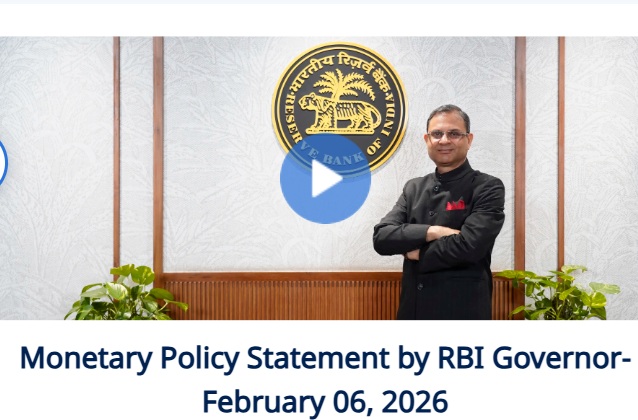
Mumbai, 6 February 2026: The Monetary Policy Committee (MPC) held its 59th meeting from February 4 to 6, 2026, under the chairmanship of Shri Sanjay Malhotra, Governor, Reserve Bank of India. The MPC members Dr. Nagesh Kumar, Shri Saugata Bhattacharya, Prof. Ram Singh, Dr. Poonam Gupta and Shri Indranil Bhattacharyya attended the meeting.
The RBI Governor Shri Sanjay Malhotra also made a Statement on Developmental and Regulatory Policies. This Statement sets out various developmental and regulatory policy measures relating to (i) Regulations; (ii) Payments System; (iii) Financial Inclusion; (iv) Financial Markets; and (v) Capacity Building.
Here is the full text of the Governor’s address:
I welcome you all to the first policy of 2026. We are only in the second month of the new year and have already witnessed momentous actions on the geopolitical and trade-tariff fronts.
2. Amidst heightened geo-political tensions and elevated uncertainty, the Indian economy is in a good spot with strong growth and low inflation. Inflation remains below the tolerance band and its outlook continues to be benign. High frequency indicators suggest continuation of the strong growth momentum in Q3:2025-26 and beyond. With the signing of a landmark trade deal with the European Union and the US trade agreement in sight, growth momentum is likely to be sustained for a longer period.
3. Global growth, supported by tech-investments, accommodative financial conditions and large-scale fiscal stimulus, is expected to be marginally stronger in 2026 than projected earlier. However, the confluence of escalating geopolitical frictions and rising trade tensions is unravelling the existing world economic order. Inflation outcomes are heterogeneous across jurisdictions – remaining above target in most major advanced economies – prompting a divergence in monetary policy actions as central banks near the end of their current easing cycles. Against a global backdrop that has increasingly become more cautious, bond market sentiments remain bearish reflecting fiscal sustainability concerns. However, equity markets, driven by tech stocks, remain upbeat.
Decisions of the Monetary Policy Committee (MPC)
4. The Monetary Policy Committee (MPC) met on the 4th, 5th and 6th of February to deliberate and decide on the policy repo rate. After a detailed assessment of the evolving macroeconomic conditions and the outlook, the MPC voted unanimously to keep the policy repo rate unchanged at 5.25 per cent; consequently, the standing deposit facility (SDF) rate under the liquidity adjustment facility (LAF) remains at 5.00 per cent and the marginal standing facility (MSF) rate and the Bank Rate at 5.50 per cent. The MPC also decided to continue with the neutral stance.
5. I shall now briefly set out the rationale for the MPC’s decision.
6. The MPC noted that since the last policy meeting, external headwinds have intensified though the successful completion of trade deals augurs well for the economic outlook. Overall, the near-term domestic inflation and growth outlook remain positive.
7. Headline inflation during November-December remained below the tolerance band of the inflation target. The revised outlook for CPI inflation in Q1:2026-27 and Q2 at 4.0 per cent and 4.2 per cent, respectively, continues to be benign and near the inflation target. The slight upward revision in the inflation outlook is primarily due to increase in prices of precious metals, which contribute about 60-70 basis points. The underlying inflation continues to be low.
8. On the growth front, economic activity remains resilient. The First Advance Estimates suggest continuing growth momentum, driven by domestic factors amidst a challenging external environment. The growth outlook remains favourable.
9. Based on a comprehensive review of the domestic macroeconomic conditions and the outlook, the MPC is of the view that the current policy rate is appropriate. Accordingly, the MPC voted to continue with the existing policy rate. The MPC also agreed to retain the neutral stance. Going forward, the MPC will be guided by the evolving macroeconomic conditions and the outlook based on data from the new series in charting the future course of monetary policy.
Assessment of Growth and Inflation
Growth
10. The Indian economy continues on a steadily improving trajectory, with real GDP poised to register significantly higher growth of 7.4 per cent in 2025-26, as compared to the previous year. Amidst global headwinds, private consumption and fixed investment supported growth.1 Net external demand, however, remained a drag, with imports outpacing exports. On the supply side, growth in real GVA, on the back of a strong contribution from the services sector and revival in manufacturing activity, is estimated at 7.3 per cent in 2025-26.2
11. Going forward, economic activity is expected to hold up well in 2026-27. Agricultural activity will be supported by healthy reservoir levels,3 robust rabi sowing,4 and improvement in crop vegetation conditions.5 Improving corporate sector performance6 and sustained momentum in informal sector should boost manufacturing activity. Construction sector growth is expected to remain firm.7 Services sector should continue to be resilient, with strengthening domestic demand.8 Early results from IT firms suggest an improvement in business activity.9
12. On the demand side, the momentum in private consumption is expected to sustain in 2026-27. Rural demand remains steady,10 with improving agricultural activity and rural labour market conditions.11 Recovery in urban consumption should further strengthen with continued support from GST rationalisation and monetary easing. High capacity utilisation,12 accelerating bank credit,13 conducive financial conditions, and government’s continued emphasis on infrastructure14 should give an impetus to investment activity. Moreover, several measures announced in the Union Budget should also be conducive for growth.15 The recently concluded India-EU free trade agreement (FTA) and the prospective India-USA trade deal along with several other trade agreements will support exports over the medium-term. Services exports should remain resilient.16 The spillovers emanating from geopolitical tensions, volatility in international financial markets and shifting trade patterns pose risks to the outlook.
13. Taking all these factors into consideration, real GDP growth projections for Q1:2026-27 and Q2 are revised upwards to 6.9 per cent and 7.0 per cent, respectively.17 The risks are evenly balanced. We are deferring the projections for the full year to the April policy as the new GDP series will be released later in the month.
Inflation
14. Headline CPI inflation remained low in November and December even as it firmed up by one percentage point in these two months. This increase was largely driven by the lower rate of deflation in the food group.18 Excluding gold, core inflation remained stable at 2.6 per cent in December19.
15. Near-term outlook suggests that food supply prospects remain bright on the back of healthy kharif production20, sufficient buffer stocks of foodgrains21, favourable rabi sowing and adequate reservoir levels. Core inflation, barring potential volatility induced by prices of precious metals, is expected to be range-bound. Geopolitical uncertainty coupled with volatility in energy prices and adverse weather events pose upside risks to inflation.
16. In terms of the headline inflation trajectory, despite the anticipated momentum being muted, unfavourable base effects stemming from large decline in prices observed during Q4:2024-25 would lead to an uptick in y-o-y inflation in Q4:2025-26. Considering all these factors, CPI inflation for 2025-26 is now projected at 2.1 per cent with Q4 at 3.2 per cent. CPI inflation for Q1:2026-27 and Q2 are projected at 4.0 per cent and 4.2 per cent, respectively. Excluding precious metals, the underlying inflation pressures remain muted. The risks are evenly balanced.
17. In view of the impending release of the new CPI series (base 2024=100) on February 12, 202622, similar to growth, we will present CPI inflation projection for the full year 2026-27 in the April 2026 Policy Statement.
External Sector
18. Despite heightened uncertainty, global trade remained relatively robust. India’s merchandise exports, supported by trade diversification efforts, grew by 1.9 per cent (y-o-y) in Q3:2025-26 whereas merchandise imports grew by 7.9 per cent (y-o-y) during the same period resulting in a widening of the trade deficit.23 Robust services exports24 and healthy inward remittance receipts25 would keep India’s current account deficit for the current year moderate and sustainable. Moreover, India’s proactive efforts in pursuing bilateral and regional trade agreements with major trading partners are expected to boost international trade and investment, diversify trading partners and integrate India into global value chains.26
19. On the external financing side, gross foreign direct investment (FDI) to India increased at a robust pace during April-November 2025. Net FDI also increased as repatriations declined, despite a rise in outward FDI.27 India continues to remain an attractive FDI destination for greenfield projects.28 Foreign portfolio investment (FPI) to India this year so far (April- February 3)29, however, recorded net outflows of US$ 5.8 billion. As on 30th January, 2026, India’s foreign exchange reserves stood at US$ 723.8 billion, providing a robust merchandise import cover of more than 11 months. Overall, India’s external sector remains resilient.30 We are confident of meeting our external financing requirements comfortably.
Liquidity and Financial Market Conditions
20. System liquidity, as measured by the net position under the Liquidity Adjustment Facility (LAF), stood at a surplus of Rs0.7 lakh crore (on a daily average basis) since the last MPC meeting in December 2025.31 The Reserve Bank undertook several measures to provide durable liquidity in December and January32. Based on assessment of systemic liquidity and its outlook, the Reserve Bank announced and undertook further durable liquidity augmenting measures in the second half of January and February 2026.33
21. In response to the cumulative 125 bps cut in the policy repo rate, the weighted average lending rate (WALR) of Scheduled Commercial Banks declined by 105 bps for fresh rupee loans during February-December 2025 (the interest rate effect34 is 94 bps)35. The weighted average domestic term deposit rate (WADTDR) on fresh deposits declined by 95 bps, while that on outstanding deposits softened by 41 bps over the same period.
22. Money market rates, especially for commercial papers (CPs) and certificates of deposit (CDs), tightened in January 2026 reflecting (i) moderation in surplus liquidity; (ii) excess supply from bunching of redemptions in CPs and CDs in January; and (iii) year-end seasonal effects.36 G-sec yields, mirroring global trends, have continued to harden over the last eight months37 due to a host of factors.
23. Going ahead, the Reserve Bank will remain proactive in liquidity management and ensure sufficient liquidity in the banking system to meet the productive requirements of the economy and to facilitate monetary policy transmission. Liquidity management would be pre-emptive with sufficient allowance for unanticipated fluctuations in government balances, changes in currency in circulation, forex intervention, etc.
Financial Stability
24. The system-level financial parameters related to capital adequacy, liquidity, asset quality and profitability of Scheduled Commercial Banks (SCBs) continue to remain robust.38 Similarly, the system-level parameters of NBFCs too are sound, with adequate capital position and improved asset quality39.
25. As per latest available data, credit from all sources grew at 13.8 per cent (y-o-y), as compared to 11.6 per cent (y-o-y) a year ago40. Bank credit growth too recorded an uptick in recent months.41 This growth42 is supported by sustained lending to all sectors, particularly retail, services and MSMEs. Large industries also recorded higher credit growth.
Additional Measures
26. I shall now announce some measures that aim to enhance customer protection, advance financial inclusion, enhance flow of credit, strengthen UCBs, promote ease of doing business for NBFCs, and deepen financial markets.
Empowering customers
27. For customer protection, we will issue three draft guidelines: one, relating to mis-selling; two, regarding recovery of loans and engagement of recovery agents; and three, on limiting liability of customers in un-authorised electronic banking transactions. It is also proposed to introduce a framework to compensate customers up to an amount of Rs25000/- for loss incurred in small-value fraudulent transactions.
28. We will also publish a discussion paper on possible measures to enhance the safety of digital payments. Such measures may include lagged credits and additional authentication for specific class of users like senior citizens.
Advancing financial inclusion and flow of credit
29. In the financial inclusion space, we have comprehensively reviewed the Lead Bank Scheme, Kisan Credit Card Scheme and the Business Correspondent Model. We shall issue draft revised guidelines with respect to them. A unified reporting portal will also be launched by us for better management of LBS data.
30. The limit of Rs10 lakh for collateral-free loans to MSMEs is proposed to be increased to Rs20 lakh.
31. To further promote financing to real estate sector, it is proposed to allow banks to lend to REITs with certain prudential safeguards.
Strengthening UCBs
32. We have four measures for UCBs.
33. The first two pertain to raising the financial limits on unsecured loans and loans to nominal members by UCBs.
34. We also propose to remove the tenor and moratorium related requirements on housing loans given by Tier III and Tier IV UCBs.
35. To strengthen the managerial and technical capacity of the UCBs, we shall launch Mission-SAKSHAM (Sahakari Bank Kshamta Nirman). The mission intends to train over 1.4 lakh participants from UCBs.
Promoting Ease of doing business for NBFCs
36. NBFCs having no public funds and customer interface, with asset size not exceeding Rs1000 crore, are proposed to be exempted from the requirement of registration.
37. Moreover, it is proposed to dispense with the requirement for certain NBFCs to obtain prior approval to open more than 1000 branches.
Deepening financial markets
38. Coming to financial markets, we had earlier issued revised draft regulations for ECBs. They have been finalized and shall be notified shortly.
39. We also propose to remove the limit of Rs2.5 lakh crore for investments under the Voluntary Retention Route (VRR). Investment through the VRR in each category of securities will be subject to the investment ceiling for the respective category under the General Route.
40. Furthermore, in pursuance of the announcement made in the Union Budget 2026-27, we propose to issue the regulatory framework for derivatives on corporate bond indices and total return swaps on corporate bonds.
41. It is also proposed to issue draft revised guidelines for Authorised Dealer banks and stand-alone primary dealers (SPDs), allowing them more flexibility in undertaking foreign exchange transactions.
Statement on Developmental and Regulatory Policies
This Statement sets out various developmental and regulatory policy measures relating to (i) Regulations; (ii) Payments System; (iii) Financial Inclusion; (iv) Financial Markets; and (v) Capacity Building.
I. Regulations
1. Advertising, Marketing and Sales of Financial Products and Services by Regulated Entities (REs)
Mis-selling financial products and services by any RE has significant consequences for both customers as well as the RE. There is a felt need to ensure that third party products and services that are being sold at the bank counters are suitable to customer needs and are commensurate with the risk appetite of individual clients. It has therefore been decided to issue comprehensive instructions to REs on advertising, marketing and sales of financial products and services. The draft instructions in this regard shall be issued shortly for public consultation.
2. Conduct of Regulated Entities in Recovery of Loans and Engagement of Recovery Agents
Currently, different sets of instructions are applicable to different categories of Regulated Entities (REs) with respect to the engagement of recovery agents and conduct related aspects of loan recovery.
It has now been decided to review and harmonise all the extant conduct related instructions on engagement of recovery agents and other aspects related to recovery of loans. Accordingly, the draft instructions in this regard shall be issued shortly for public consultation.
3. Review of framework of Limiting Customer Liability in digital transactions
The extant instructions on limiting the liability of customers in unauthorised electronic banking transactions were issued in 2017, which deal with scenarios and timelines for zero / limited liability of a customer. In view of the rapid adoption of technology in the banking sector and payments systems, since issuance of these instructions, the existing instructions have been reviewed. Accordingly, the draft revised instructions, including a framework for compensation in case of small value fraudulent transactions, shall be issued shortly for public consultation.
4. Bank Lending to Real Estate Investment Trusts (REITs)
Real Estate Investment Trusts (REITs) and Infrastructure Investment Trusts (InvITs) were conceptualised in India with a view to free up banks’ funds in completed and operational real estate and infrastructure projects by refinancing such exposures with pooled funds of institutional as well as retail investors. Consistent with these objectives, commercial banks were not permitted, ab initio, to lend to these entities. While bank lending to InvITs was allowed subsequently, lending to REITs was not permitted hitherto. Upon review and considering the presence of strong regulatory and governance framework for listed REITs, it is proposed to permit commercial banks to extend finance to REITs, subject to appropriate prudential safeguards. The existing guidelines in respect of lending to InvITs are also being harmonised for parity with prudential safeguards proposed for lending to REITs. Draft directions in this regard will be issued shortly for public consultation.
5. Review of Lending norms for UCBs
In the recent past, several regulatory measures have been undertaken with the objective of providing greater flexibility to UCBs in their lending operations. It is now proposed to rationalise the extant regulatory norms applicable for unsecured loans by UCBs; limits for lending to nominal members; and the tenor and moratorium requirements for housing loans. The proposed review shall adopt inter alia, a tiered and simplified approach while maintaining prudential discipline, taking into consideration the growth in total loans and advances of the UCBs over the past few years. Draft directions in this regard will be issued shortly for public consultation.
6. Exemption from registration to eligible NBFCs not availing public funds and not having customer interface (including ‘Type I NBFCs’)
The Scale-Based Regulatory Framework for NBFCs envisages differential regulatory treatment for NBFCs that do not avail public funds and do not have any customer interface. Given their unique nature, a review of the regulations presently applicable to these NBFCs has been undertaken. Considering their significantly lower systemic-risk profile, it is proposed that such Type-I NBFCs with asset size not exceeding Rs1,000 crore, may be exempted from registration requirement with the Reserve Bank subject to certain specified conditions. The proposed exemption will reduce compliance requirements for these NBFCs. Accordingly, draft Amendment Directions will be issued shortly for feedback from stakeholders.
7. Amendment of NBFC Branch Authorisation Directions-2025
At per extant regulatory requirement, NBFC - Investment and Credit Companies (ICCs) engaged in the business of lending against gold collateral with over 1,000 branches are required to obtain prior RBI approval for opening new branches. In view of the comprehensive prudential and governance framework applicable to NBFC-ICCs, it is proposed to dispense with the requirement of prior approval for opening branches by such NBFCs. The draft instructions in this regard shall be issued shortly seeking stakeholders’ comments.
II. Payments System
8. Discussion Paper on “Exploring safeguards in digital payments to curb frauds”
Over the past decade, digital payments in India have expanded at an unprecedented pace, reflecting a structural shift in the way individuals and businesses conduct financial transactions. However, it has been accompanied with growing sophistication of fraudulent activities targeting innocent customers. In alignment with the objective of promoting digital payments in a safe and secure manner, it is proposed to issue a Discussion Paper exploring the introduction of calibrated safeguards in digital payments such as introduction of lagged credits, additional authentication for specific class of users like senior citizens, etc. The proposed measures are intended to mitigate frauds and strengthen customer protection.
III. Financial Inclusion
9. Revision in Lead Bank Scheme
The Reserve Bank has undertaken a detailed review of the existing guidelines on Lead Bank Scheme (LBS). It is now proposed to issue a comprehensive set of instructions on the Scheme with a view to streamline the operational aspects. In the revised Scheme, the objectives of LBS and the framework to achieve them are proposed to be delineated clearly. The revised guidelines are expected to enhance the effectiveness of the Scheme. The draft Circular will be issued shortly for public consultation. In addition, the Reserve Bank will be launching a unified portal for reporting of Bank-wise LBS data which is currently fragmented across various portals. This is expected to significantly enhance the data quality and provide better insights towards achieving the objectives of LBS.
10. Revision in the Guidelines of Kisan Credit Card (KCC)
The Reserve Bank has comprehensively reviewed the KCC Scheme with a view to expand coverage, streamline operational aspects and address emerging requirements. It is now proposed to issue a revised set of instructions to banks on the Scheme, consolidating those on agriculture and allied activities. The proposed guidelines include, among others, standardisation of crop season, extension of KCC tenure to six years, alignment of drawing limit with Scale of Finance (SoF) for each crop season and inclusion of expenses on technological interventions. The draft guidelines will be issued shortly.
11. Review of guidelines relating to use of Business Correspondents (BCs) by banks
Business Correspondents have been functioning as critical enablers of last mile access to financial services, particularly in respect of underserved, rural, and remote locations. Reserve Bank had set up a committee, consisting of officials from Reserve Bank, DFS, IBA and NABARD, to comprehensively examine their operations and make suitable recommendations for enhancing their efficiency. Basis the Committee’s recommendations, the related regulatory guidelines are being reviewed, and the draft amendment directions will be placed for public consultations shortly.
12. Enhancement in Collateral free loan limit from Rs10 lakh to Rs20 lakh
With a view to facilitate improved access to formal credit, support entrepreneurial activity and strengthen last mile credit delivery for Micro and Small Enterprises (MSEs) with limited collateral, it has been decided to enhance the limit of collateral free loans to MSEs from Rs10 lakh to Rs20 lakh. The above provisions shall be applicable to all loans to MSE borrowers sanctioned or renewed on or after April 01, 2026. Instructions in this regard will be issued shortly.
IV. Financial Markets
13. Development of corporate bond market
An active derivatives market can facilitate efficient management of credit risks, improve liquidity and efficiency in the corporate bond market and facilitate issuance of corporate bonds across the rating spectrum. An announcement was made in the Union Budget speech delivered on February 1, 2026, that total return swaps on corporate bonds and derivatives on corporate bond indices will be introduced. Accordingly, a regulatory framework to enable the introduction of derivatives on credit indices and total return swaps on corporate bonds will be issued shortly for public feedback.
14. Foreign Exchange Dealings of Authorised Dealers
Banks and standalone primary dealers authorised under FEMA, 1999, access the foreign exchange market for market making, balance sheet management and hedging of risks. The regulatory framework governing the facilities for such Authorised Dealers (ADs) has been reviewed, rationalised and refined in view of the current market practices and requirements, domestically and globally. The revised framework provides these ADs with greater flexibility with respect to foreign exchange products, risk management and platforms. Draft directions in this regard will be issued shortly for public consultation.
15. Review of the Voluntary Retention Route for FPI investment in debt instruments
The Voluntary Retention Route (VRR) was introduced by the Reserve Bank in March 2019 to provide an additional channel for investments by Foreign Portfolio Investors (FPIs) with long-term investment interest in the Indian debt markets. Over the years, the Bank has been recalibrating the Route to improve operational flexibilities and ease of doing business. The VRR has been witnessing active investment by FPIs, and over 80 per cent of the current investment limit of Rs2.5 lakh crore has been utilised. With a view to ensuring predictability about the availability of investment limits under the VRR and to further increase ease of doing business, it has been decided that (a) investments under the VRR shall now be reckoned under the limit for FPI investments under the General Route; and (b) certain additional operational flexibilities will be provided to FPIs investing under the VRR. Necessary directions will be separately issued.
V. Capacity Building
16. Mission Saksham – Capacity Building for the UCB Sector
Primary (Urban) Co-operative Banks (UCBs) are vital institutions for promoting financial inclusion and serving the unbanked. Securing their next phase of growth would depend on developing stronger skills and competencies, along with technical capabilities and operational resilience in them. To serve this objective, the Reserve Bank will soon be launching Mission SAKSHAM (Sahakari Bank Kshamta Nirman)- a sector-wide capacity-building and certification framework. The capacity building of the sector would be implemented through a large number of physical training programmes as well as a scalable learning platform, to cover about 1.40 lakh participants, across all functions. The Reserve Bank shall endeavour to conduct these training programmes at locations close to participating UCBs, with content delivery in regional languages to the extent feasible. The Mission will be pursued in partnership with the Umbrella Organisation of UCBs and National / State Federations.
Concluding Remarks
42. Before I conclude, I would like to inform that the Reserve Bank observes Financial Literacy Week (FLW) every year on specific themes of financial education. The campaign this year will be launched on 9th February. In continuation of our ongoing endeavour on re-KYC of bank accounts, the theme this year is ‘KYC – Your First Step to Safe Banking’. I urge all banks to actively take part in the campaign.
43. To conclude, the Indian economy continues to register high growth despite a challenging external environment clouded by geo-political uncertainties. Benign inflation provides the leeway to remain growth-supportive while preserving financial stability. We remain committed to meet the productive requirements of the economy and sustain the growth momentum.
44. Thank you. Namaskar and Jai Hind.
